| Reliability and Quality Design |
|

|
|
|
| Multi-state reliability analysis of train control center system |
Xian WU1( ),Wenzhe QI1(),Jinping QI1,2,Tian PENG3,Qiangye YU1 ),Wenzhe QI1(),Jinping QI1,2,Tian PENG3,Qiangye YU1 |
1.School of Mechanical and Electrical Engineering, Lanzhou Jiaotong University, Lanzhou 730070, China
2.Research Institute, Lanzhou Jiaotong University, Lanzhou 730070, China
3.Research Institute, CRRC Datong Electric Locomotive Co. , Ltd. , Datong 037006, China |
|
|
|
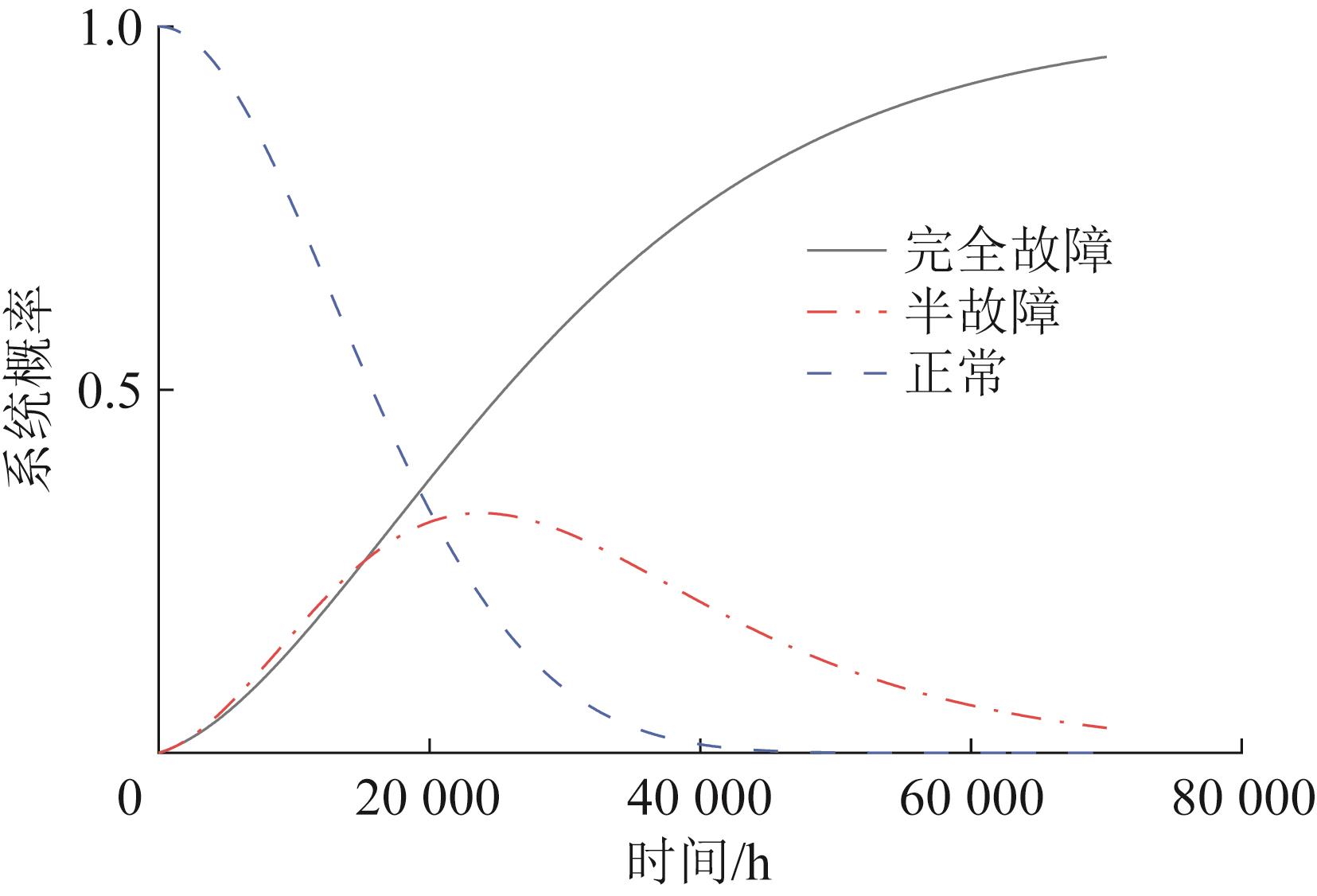
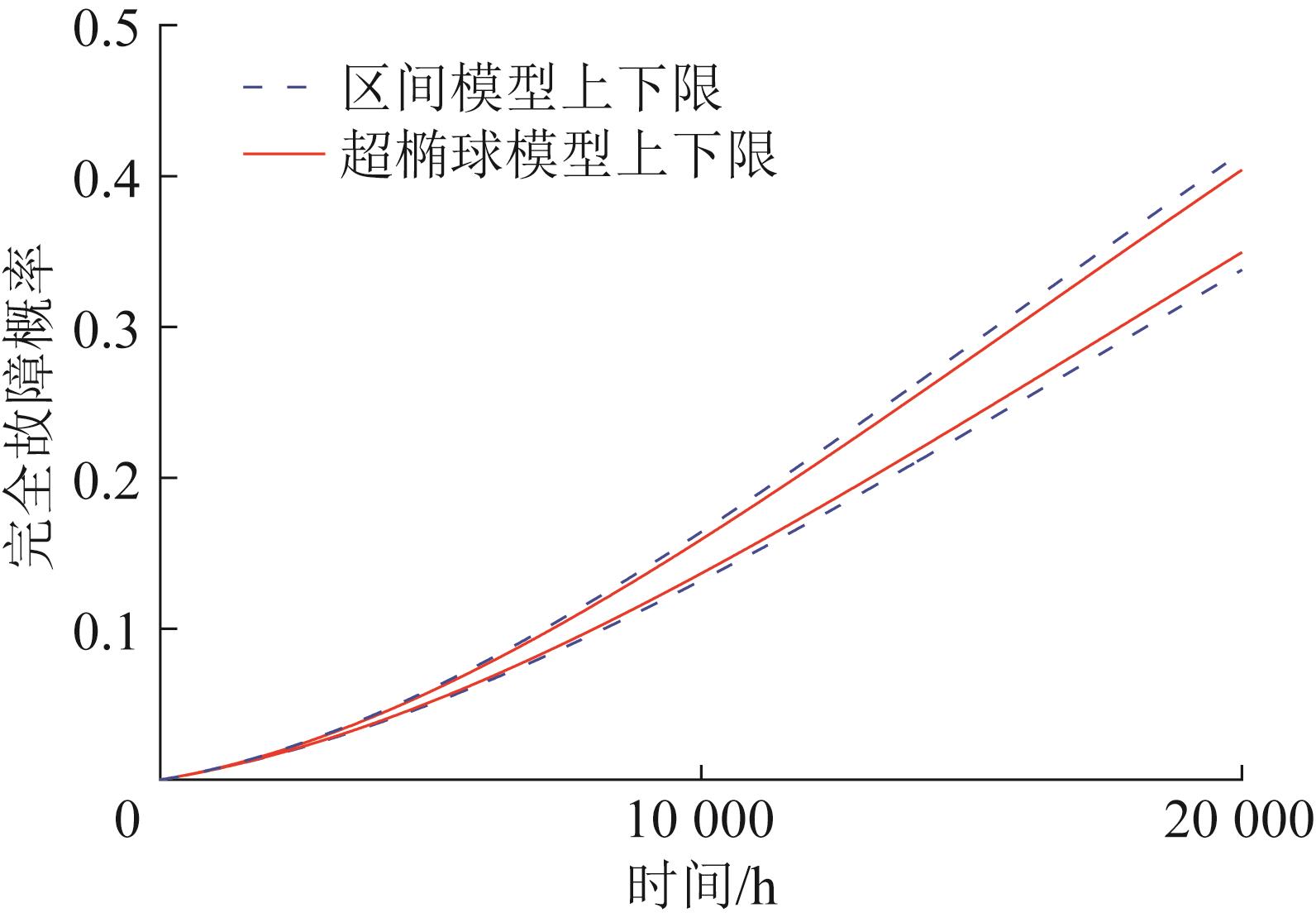
Abstract Due to the dynamic and polymorphic characteristics of fault modes in train control center, traditional continuous-time Bayesian network fails to effectively address the the issue of polymorphism. Moreover, missing fault data in practical engineering makes it difficult to obtain accurate fault data.To overcome these challenges, this paper proposed a reliability analysis method integrating hyper-ellipsoidal T-S fault tree with Bayesian network.Firstly, the hyper-ellipsoid model was employed to constrain the probability interval of bottom events, in order to address the issue of data uncertainty.Secondly, a Bayesian network model was constructed based on the T-S fault tree, and the fuzzy numbers were used to characterize multiple fault states of the nodes. Finally, the proposed method was used to analyze the reliability of the train control center system. Through forward reasoning, the probability curves for each state during the system operation were obtained. Through posterior probability analysis, the vulnerable components of the system were identified.The research results demonstrated that compared with the conventional interval T-S fault tree, the analysis accuracy and reasoning capability of the proposed method had been improved. Additionally, the forward reasoning and posterior probability analysis results can provide theoretical support for the maintenance and reliability optimization of the train control center.
|
|
Received: 04 September 2025
Published: 27 June 2026
|
|
|
|
Corresponding Authors:
Wenzhe QI
E-mail: 956079218@qq.com;qiwz@mail.lzjtu.cn
|
列车控制中心系统多态可靠性分析
列车控制中心的故障模式具有动态性和多态性,而传统连续时间贝叶斯网络无法有效解决多态的问题,且在实际工程中存在故障数据缺失等情况,难以获得准确的故障数据。为此,提出了一种结合超椭球T-S故障树和贝叶斯网络的可靠性分析方法。首先,利用超椭球模型对底事件的概率区间进行约束,以解决数据不确定性的问题;其次,基于T-S故障树构造贝叶斯网络模型,用模糊数描述节点的多故障状态;最后,采用所提出的方法对列车控制中心系统的可靠性进行分析,通过正向推理得到了系统运行中各状态的概率曲线,通过后验概率分析识别了系统的薄弱环节。研究结果表明:相较于传统区间T-S故障树,所提出方法的分析精度与推理能力均有所提升,同时正向推理及后验概率分析结果可为列车控制中心的维护与可靠性优化提供理论支持。
关键词:
列车控制中心,
超椭球模型,
贝叶斯网络,
多故障状态,
可靠性分析
|
|
| [[1]] |
北京全路通信信号研究设计院集团有限公司. 列控中心测试规范: [S]. 北京:中国铁道出版社有限公司,2016:1-26.
CRSC Research & Design Institute Group Co., Ltd.. Test specification for train control center: [S]. Beijing: China Railway Publishing House Co., Ltd., 2016: 1-26.
|
|
|
| [[2]] |
国务院“ 7·23”甬温线特别重大铁路交通事故调查组. “7·23” 甬温线特别重大铁路交通事故调查报告[R/OL]. (2011-11-28)[2025-08-20]. .
Investigation Group of Particularly Serious Railway Traffic Accidents on the “July 23” Yongwen Line of the State. Investigation report on particularly serious railway traffic accidents on the “July 23” Yongwen Line[R/OL]. (2011-11-28)[2025-08-20]. .
|
|
|
| [[3]] |
董国庆. 列控中心系统可靠性及安全风险评估方法研究[D]. 兰州: 兰州交通大学, 2023.
DONG G Q. Research on reliability and safety risk evaluation method of on-board train control center system[D]. Lanzhou: Lanzhou Jiatong University, 2023.
|
|
|
| [[4]] |
齐金平, 王康, 李少雄, 等. 基于Markov的列控中心多态动态可靠性分析[J]. 安全与环境学报, 2022, 22(6): 2962-2970.
QI J P, WANG K, LI S X, et al. Multi-state and dynamic reliability analysis of TCC based on Markov[J]. Journal of Safety and Environment, 2022, 22(6): 2962-2970.
|
|
|
| [[5]] |
LIU W F, SUN H T, YUN F H. Reliability analysis of multi-state systems for subsea connector under dynamic pressure based on the Markov process[J]. Measurement, 2025, 252: 117389.
|
|
|
| [[6]] |
AHMADI M, SHEKHAR A, BAUER P. Reliability assessment for modular multilevel converters using Monte Carlo simulations[J]. International Journal of Electrical Power & Energy Systems, 2025, 165: 110482.
|
|
|
| [[7]] |
姚成玉, 韩丁丁, 陈东宁, 等. 考虑共因失效的新型连续时间动态贝叶斯网络可靠性分析方法[J]. 仪器仪表学报, 2022, 43(6): 174-184.
YAO C Y, HAN D D, CHEN D N, et al. A novel continuous-time dynamic Bayesian network reliability analysis method considering common cause failure[J]. Chinese Journal of Scientific Instrument, 2022, 43(6): 174-184.
|
|
|
| [[8]] |
刘雅萍, 卢兴旺, 戴鑫亮. 基于T-S模糊故障树的转向架多态可靠性研究[J]. 机械, 2022, 49(7): 29-35.
LIU Y P, LU X W, DAI X L. Multi-state reliability study of bogies based on T-S fuzzy fault tree[J]. Machinery, 2022, 49(7): 29-35.
|
|
|
| [[9]] |
邢贺亮. 基于多态T-S动态故障树的风电机组液压系统可靠性分析[D]. 秦皇岛: 燕山大学, 2021.
XING H L. Reliability analysis of wind turbine hydraulic system based on polymorphic T-S dynamic fault tree[D]. Qinhuangdao: Yanshan University, 2021.
|
|
|
| [[10]] |
陈意. 连续时间多态T-S动态故障树分析方法及应用[D]. 秦皇岛: 燕山大学, 2023.
CHEN Y. Continuous-time multi-state T-S dynamic fault tree analysis method and its applications[D]. Qinhuangdao: Yanshan University, 2023.
|
|
|
| [[11]] |
BOUDALI H, DUGAN J B. A continuous-time Bayesian network reliability modeling, and analysis framework[J]. IEEE Transactions on Reliability, 2006, 55(1): 86-97.
|
|
|
| [[12]] |
LI S, CHEN Z Y, LIU Q B, et al. Modeling and analysis of performance degradation data for reliability assessment: a review[J]. IEEE Access, 2020, 8: 74648-74678.
|
|
|
| [[13]] |
董升, 马云洁, 周继彪, 等. 基于D-S证据理论的地铁站安全风险评估方法[J]. 交通信息与安全, 2025, 43(2): 28-35.
DONG S, MA Y J, ZHOU J B, et al. A method of risk assessment for subway stations based on D-S evidence theory[J]. Journal of Transport Information and Safety, 2025, 43(2): 28-35.
|
|
|
| [[14]] |
米红甫, 王莉莉, 邵鹏. 基于超椭球T-S故障树的储气库注采井可靠性分析[J]. 安全与环境工程, 2025, 32(1): 118-126, 156.
MI H F, WANG L L, SHAO P. Reliability analysis of gas storage injection-production well based on hyper-ellipsoid T-S fault tree[J]. Safety and Environmental Engineering, 2025, 32(1): 118-126, 156.
|
|
|
| [[15]] |
TIAN Y J, WEN J, ZHENG S B. Reliability analysis of vehicle braking system based on hyperellipsoidal dynamic Bayesian network[J]. Applied Sciences, 2025, 15(3): 1290.
|
|
|
| [[16]] |
赵新超, 吕卫民, 金国富. 基于性能退化与D-S证据理论的可靠性评估方法[J]. 兵工自动化, 2019, 38(4): 53-56, 83.
ZHAO X C, LÜ W M, JIN G F. Reliability evaluation method based on performance degradation and D-S evidence theory[J]. Ordnance Industry Automation, 2019, 38(4): 53-56, 83.
|
|
|
| [[17]] |
邢然. 一种新型连续时间贝叶斯网络分析方法[D]. 秦皇岛: 燕山大学, 2020: 1-70.
XING R. A novel continuous-time Bayesian network analysis method[D]. Qinhuangdao: Yanshan University, 2020: 1-70.
|
|
|
| [[18]] |
谢昕昊, 王小敏, 江磊. 基于连续时间贝叶斯网络的CTC车站系统可靠性分析[J]. 铁道标准设计, 2025, 69(8): 193-200.
XIE X H, WANG X M, JIANG L. Reliability analysis of CTC station systems based on a continuous-time Bayesian network[J]. Railway Standard Design, 2025, 69(8): 193-200.
|
|
|
| [[19]] |
王康, 齐金平. 基于超椭球Markov的列车控制中心剩余使用寿命预测[J]. 铁路计算机应用, 2024, 33(2): 67-73.
WANG K, QI J P. Prediction of remaining service life of train control center based on hyper-ellipsoidal Markov[J]. Railway Computer Application, 2024, 33(2): 67-73.
|
|
|
| [[20]] |
姚成玉, 陈东宁, 王斌. 基于T-S故障树和贝叶斯网络的模糊可靠性评估方法[J]. 机械工程学报, 2014, 50(2): 193-201. doi:10.3901/jme.2014.02.193
YAO C Y, CHEN D N, WANG B. Fuzzy reliability assessment method based on T-S fault tree and Bayesian network[J]. Journal of Mechanical Engineering, 2014, 50(2): 193-201.
doi: 10.3901/jme.2014.02.193
|
|
|
| [[21]] |
吴限, 祁文哲, 齐金平, 等. 基于连续时间贝叶斯网络的列控中心可靠性分析[J]. 铁道通信信号, 2025, 61(8): 23-30.
WU X, QI W Z, QI J P, et al. Reliability analysis of train control center based on continuous-time Bayesian network[J]. Railway Signalling & Communication, 2025, 61(8): 23-30.
|
|
|
|
Viewed |
|
|
|
Full text
|
|
|
|
|
Abstract
|
|
|
|
|
Cited |
|
|
|
|
| |
Shared |
|
|
|
|
| |
Discussed |
|
|
|
|