|
|
|
| Dual-branch point cloud semantic segmentation algorithm based on multimodal knowledge alignment |
Jun YANG1,2( ),Hengrui MAO1,Jisheng DANG3,4 ),Hengrui MAO1,Jisheng DANG3,4 |
1. School of Automation and Electrical Engineering, Lanzhou Jiaotong University, Lanzhou 730070, China
2. School of Electronic and Information Engineering, Lanzhou Jiaotong University, Lanzhou 730070, China
3. School of Computer Science and Engineering, National University of Singapore, Kent Ridge 119077, Singapore
4. School of Information Science and Engineering, Lanzhou University, Lanzhou 730070, China |
|
|
|
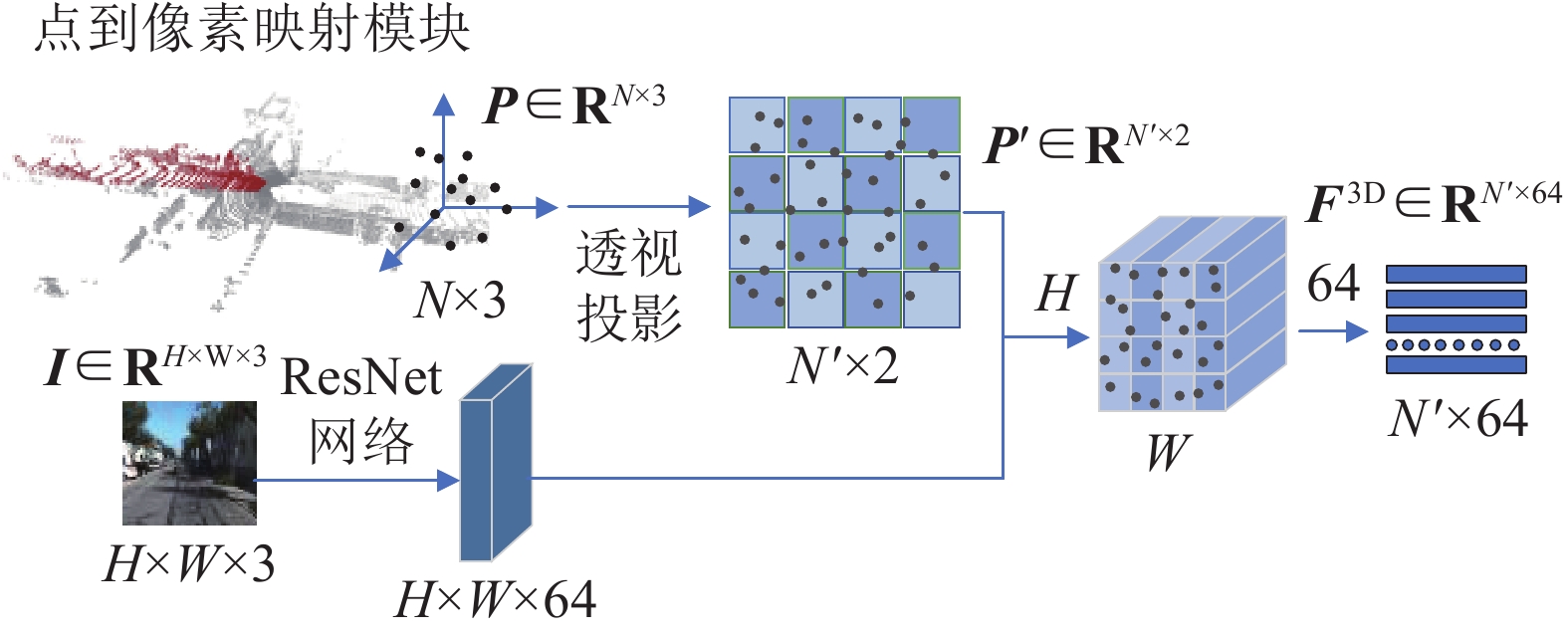
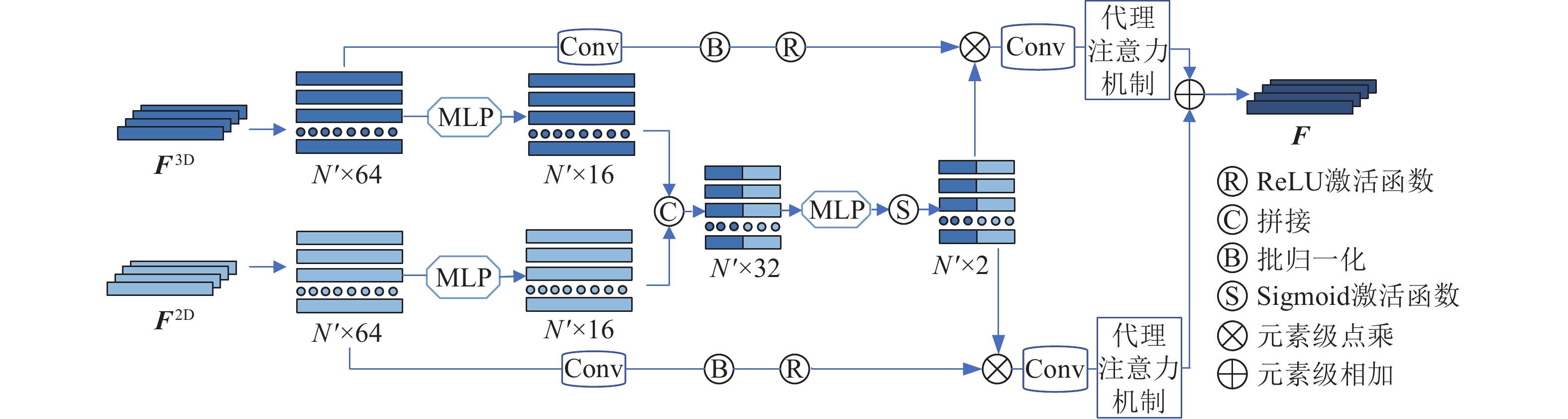
Abstract A multimodal point cloud semantic segmentation algorithm assisted by 2D image information was proposed in response to the excessive computational cost introduced by incorporating 2D image information in multimodal semantic segmentation methods, as well as the significant feature discrepancy and fusion difficulty between different modalities. A dual-branch feature extraction network was employed to separately extract point cloud feature and RGB image feature. A feature separation convolution was designed to optimize the extracted 2D image feature in order to reduce the additional computational burden caused by the introduction of RGB images. A point-to-pixel mapping strategy was adopted to transform 3D point cloud feature into a representation compatible with 2D image feature. A multimodal knowledge alignment module was designed. The key feature of point cloud and RGB image was emphasized through a dual-fusion attention mechanism. Then the point cloud feature and RGB image feature were mapped into a unified feature space. The discrepancy between modalities was eliminated, thereby allowing the model to perceive the environment more comprehensively. The proposed algorithm achieved semantic segmentation accuracy of 69.1% and 79.3% on the SemanticKITTI and NuScenes datasets, respectively, outperforming other mainstream algorithms. The experimental results demonstrate that the proposed algorithm effectively improves the accuracy of point cloud semantic segmentation by combining point cloud information with RGB image information and exploiting the complementary advantage of multimodal data.
|
|
Received: 14 October 2025
Published: 20 July 2026
|
|
|
| Fund: 国家自然科学基金资助项目(42261067);2025年度甘肃省重点人才资助项目(2025RCXM031). |
基于多模态知识对齐的双分支点云语义分割算法
针对多模态语义分割方法中因引入二维图像信息而带来的额外计算量,以及不同模态之间特征差异显著、融合困难等问题,提出基于二维图像信息辅助的多模态点云语义分割算法. 通过双分支特征提取网络分别提取点云特征和RGB图像特征. 为了减少因引入RGB图像而带来的额外计算负担,设计特征分离卷积,优化所提取的二维图像特征. 采用点到像素的映射策略,将三维点云特征转换为与二维图像特征兼容的表示形式. 设计多模态知识对齐模块,通过双融合注意力机制聚焦点云和RGB图像的关键特征,使点云特征与RGB图像特征映射到统一的特征空间,消除模态间的差异,使得模型能够更全面地感知环境. 该算法在SemanticKITTI和NuScenes数据集上的语义分割精度分别达到69.1%和79.3%,优于其他主流算法. 实验结果表明,该算法通过结合点云信息与RGB图像信息,发挥多模态数据的互补优势,有效提升点云语义分割的精度.
关键词:
RGB图像数据,
点云数据,
点云语义分割,
多模态知识对齐,
特征分离卷积
|
|
| [23] |
QIU S, LI X, XUE X, et al. PC-BEV: an efficient polar-Cartesian BEV fusion framework for LiDAR semantic segmentation [C]//Proceedings of the AAAI Conference on Artificial Intelligence. [S. l.]: AAAI Press, 2025, 39(6): 6612–6620.
|
|
|
| [24] |
YAN X, GAO J, ZHENG C, et al. 2DPASS: 2D priors assisted semantic segmentation on LiDAR point clouds [C]//Proceedings of the European Conference on Computer Vision. Cham: Springer, 2022: 677–695.
|
|
|
| [1] |
SONG Z, LIU L, JIA F, et al Robustness-aware 3D object detection in autonomous driving: a review and outlook[J]. IEEE Transactions on Intelligent Transportation Systems, 2024, 25 (11): 15407- 15436
doi: 10.1109/TITS.2024.3439557
|
|
|
| [2] |
LUO H, ZHANG J, LIU X, et al Large-scale 3D reconstruction from multi-view imagery: a comprehensive review[J]. Remote Sensing, 2024, 16 (5): 773- 811
doi: 10.3390/rs16050773
|
|
|
| [3] |
LI H, ZHU G, ZHANG L, et al Scene graph generation: a comprehensive survey[J]. Neurocomputing, 2024, 566: 127052- 127077
doi: 10.1016/j.neucom.2023.127052
|
|
|
| [4] |
ZHAO J, ZHAO W, DENG B, et al Autonomous driving system: a comprehensive survey[J]. Expert Systems with Applications, 2024, 242: 122836
doi: 10.1016/j.eswa.2023.122836
|
|
|
| [5] |
MYSTAKIDIS S Metaverse[J]. Encyclopedia, 2022, 2 (1): 486- 497
doi: 10.3390/encyclopedia2010031
|
|
|
| [6] |
GARCIA E, JIMENEZ M A, DE SANTOS P G, et al The evolution of robotics research[J]. IEEE Robotics and Automation Magazine, 2007, 14 (1): 90- 103
doi: 10.1109/MRA.2007.339608
|
|
|
| [7] |
YING S, VAN OOSTEROM P, FAN H New techniques and methods for modelling, visualization, and analysis of a 3D city[J]. Journal of Geovisualization and Spatial Analysis, 2023, 7 (2): 26- 29
doi: 10.1007/s41651-023-00157-x
|
|
|
| [8] |
SHELHAMER E, LONG J, DARRELL T. Fully convolutional networks for semantic segmentation [C]// Proceedings of the IEEE Conference on Computer Vision and Pattern Recognition. Boston: IEEE, 2015: 3431–3440.
|
|
|
| [9] |
ZHOU J, HAO M, ZHANG D, et al Fusion PSPnet image segmentation based method for multi-focus image fusion[J]. IEEE Photonics Journal, 2019, 11 (6): 6501412
doi: 10.1080/19479832.2020.1791262
|
|
|
| [10] |
CHEN L C, PAPANDREOU G, KOKKINOS I, et al DeepLab: semantic image segmentation with deep convolutional nets, atrous convolution, and fully connected CRFs[J]. IEEE Transactions on Pattern Analysis and Machine Intelligence, 2017, 40 (4): 834- 848
doi: 10.1109/tpami.2017.2699184
|
|
|
| [25] |
ZHUANG Z, LI R, JIA K, et al. Perception-aware multi-sensor fusion for 3D LiDAR semantic segmentation [C]//Proceedings of the IEEE/CVF International Conference on Computer Vision. Montreal: IEEE, 2022: 16260–16270.
|
|
|
| [11] |
杨军, 张琛 融合双注意力机制和动态图卷积的点云语义分割[J]. 北京航空航天大学学报, 2024, 50 (10): 2984- 2994
YANG Jun, ZHANG Chen Semantic segmentation of point clouds by fusing dual attention mechanism and dynamic graph convolution[J]. Journal of Beijing University of Aeronautics and Astronautics, 2024, 50 (10): 2984- 2994
doi: 10.13700/j.bh.1001-5965.2022.0775
|
|
|
| [12] |
杨军, 党吉圣 基于上下文注意力CNN的三维点云语义分割[J]. 通信学报, 2020, 41 (7): 195- 203
YANG Jun, DANG Jisheng Semantic segmentation of 3D point cloud based on contextual attention CNN[J]. Journal on Communications, 2020, 41 (7): 195- 203
doi: 10.11959/j.issn.1000-436x.2020128
|
|
|
| [13] |
LI B, MAO B 3D cadaster creation from generalized blueprint based on semantic boundary point extraction[J]. Journal of Geovisualization and Spatial Analysis, 2022, 6 (2): 21- 32
doi: 10.1007/s41651-022-00113-1
|
|
|
| [14] |
ZHANG C, LIU M, XU D, et al. Multi-modal 3D point cloud and image fusion for semantic segmentation in autonomous driving [C]// Proceedings of the IEEE/CVF International Conference on Computer Vision. Montreal: IEEE, 2021: 1356–1364.
|
|
|
| [15] |
BEHLEY J, GARBADE M, MILIOTO A, et al. SemanticKITTI: a dataset for semantic scene understanding of LiDAR sequences [C]//Proceedings of the IEEE/CVF International Conference on Computer Vision. Seoul: IEEE, 2020: 9296–9306.
|
|
|
| [16] |
CAESAR H, BANKITI V, LANG A H, et al. nuScenes: a multimodal dataset for autonomous driving [C]//Proceedings of the IEEE/CVF Conference on Computer Vision and Pattern Recognition. Seattle: IEEE, 2020: 11621–11631.
|
|
|
| [17] |
QI C R, YI L, SU H, et al. PointNet++: deep hierarchical feature learning on point sets in a metric space [C]// Advances in Neural Information Processing Systems. [S. l.]: Curran Associates, 2017, 30: 5099–5108.
|
|
|
| [18] |
ZHOU H, ZHU X, SONG X, et al. Cylinder3D: an effective 3D framework for driving-scene LiDAR semantic segmentation [EB/OL]. (2020-08-04)[2025-10-13]. https://arxiv.org/abs/2008.01550.
|
|
|
| [19] |
LI R, LI S, CHEN X, et al. TFNet: exploiting temporal cues for fast and accurate LiDAR semantic segmentation [C]//Proceedings of the IEEE/CVF Conference on Computer Vision and Pattern Recognition. Seattle: IEEE, 2024: 4547–4556.
|
|
|
| [20] |
PUY G, BOULCH A, MARLET R. Using a waffle iron for automotive point cloud semantic segmentation [C]//Proceedings of the IEEE/CVF International Conference on Computer Vision. Paris: IEEE, 2024: 3379–3389.
|
|
|
| [21] |
SÁNCHEZ-GARCÍA F, MONTIEL-MARÍN S, ANTUNES-GARCÍA M, et al SalsaNext+: a multimodal-based point cloud semantic segmentation with range and RGB images[J]. IEEE Access, 2025, 13: 64133- 64147
doi: 10.1109/ACCESS.2025.3559580
|
|
|
|
Viewed |
|
|
|
Full text
|
|
|
|
|
Abstract
|
|
|
|
|
Cited |
|
|
|
|
| |
Shared |
|
|
|
|
| |
Discussed |
|
|
|
|