|
|
|
| Identification of core driving factors for product architecture design based on dual-layer complex network |
Shifeng LIU1( ),Jianning SU2,*(),Shutao ZHANG2,Shijie WANG1,Kai QIU2,Wenjin YANG2 ),Jianning SU2,*(),Shutao ZHANG2,Shijie WANG1,Kai QIU2,Wenjin YANG2 |
1. School of Mechanical and Electrical Engineering, Lanzhou University of Technology, Lanzhou 730050, China
2. School of Architecture and Art Design, Lanzhou University of Technology, Lanzhou 730050, China |
|
|
|
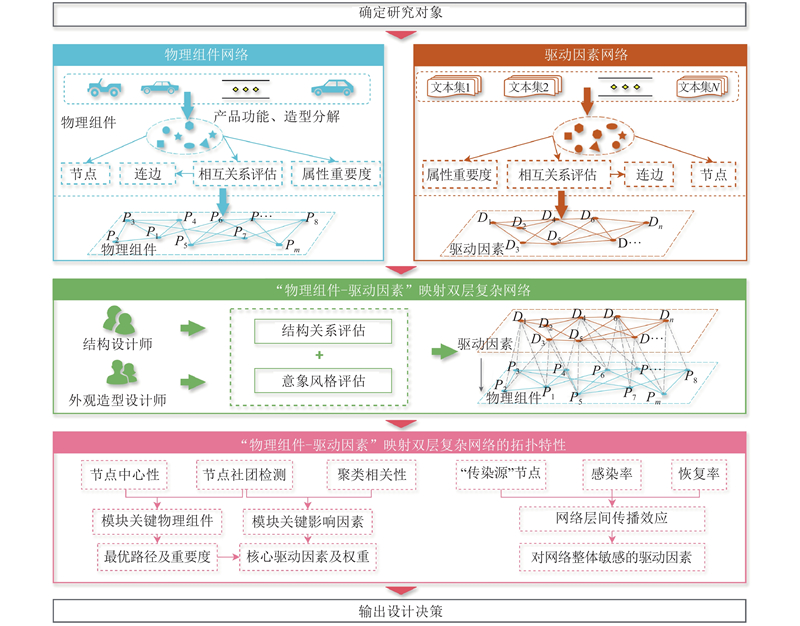
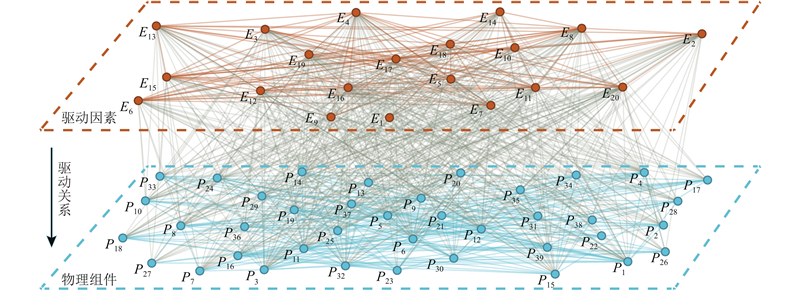
Abstract A method based on a dual-layer complex network was proposed to resolve two problems in product design: the difficulty in synergizing functional structure solutions with aesthetic appearance solutions, and the ambiguous and complex many-to-many mappings between multi-source driving factors and physical components. First, based on the ontological characteristics of product architecture and the natural language processing techniques, a physical component network was constructed to represent the topological relationships among physical components, and a driving factor network was built to reflect the semantic relationships among multi-source driving factors. Then, based on design cognitive characteristics, a dual-layer complex network was established to map the relationships between physical components and driving factors, enabling the quantitative representation of the complex influence of multi-source driving factors on physical components under design cognitive constraints. Finally, through multi-dimensional topological feature fusion analysis, the core driving factors and their weights for physical components were identified under the combined effects of intra-layer and inter-layer nodes on physical components. The results indicate that the influence of multi-source driving factors on the product architecture design exhibits characteristics of multi-level chain effects and synergistic interactions. Additionally, the synergistic relationship between functional structure and aesthetic appearance should be considered. A case study on automotive architecture demonstrates the feasibility of the proposed method.
|
|
Received: 10 July 2025
Published: 16 July 2026
|
|
|
| Fund: 国家自然科学基金资助项目(52165033);甘肃省青年科技计划资助项目(24JRRA968);甘肃省教育厅高校教师创新基金资助项目(2023A-024). |
|
Corresponding Authors:
Jianning SU
E-mail: liusf@lut.edu.cn;sujn@lut.edu.cn
|
基于双层复杂网络的产品架构设计核心驱动因素识别
为了解决产品设计中物理组件的功能结构解与外观美学解难协同、多源驱动因素与物理组件之间“多对多”复杂映射关系不清晰的问题,提出双层复杂网络分析多源驱动因素对产品架构设计的复杂影响关系. 基于产品架构本体特性和自然语言处理技术,分别构建表征物理组件之间拓扑关联的物理组件网络和反映多源驱动因素之间语义关系的驱动因素网络;基于设计认知特性建立“物理组件-驱动因素”映射的双层复杂网络,定量表征设计认知约束下多源驱动因素对物理组件的复杂作用关系;通过多维拓扑特征融合分析,识别物理组件在层内与层间节点双重作用下的核心驱动因素及其权重. 结果表明,多源驱动因素对产品架构设计的影响具有多层级链式驱动和协同交互驱动的特征;应该关注功能结构和外观美学关系的协同作用. 以汽车架构为例进行分析,验证了提出方法的可行性.
关键词:
产品架构,
多源驱动因素,
物理组件,
设计认知,
双层复杂网络
|
|
| [1] |
陆蔚华, 倪祎寒, 蔡志彬, 等 用户评论数据驱动的产品优化设计方法[J]. 计算机辅助设计与图形学学报, 2022, 34 (3): 482- 490
LU Weihua, NI Yihan, CAI Zhibin, et al User review data-driven product optimization design method[J]. Journal of Computer-Aided Design and Computer Graphics, 2022, 34 (3): 482- 490
doi: 10.3724/SP.J.1089.2022.19097
|
|
|
| [2] |
RAJA V, JOHANNESSON H, ISAKSSON O Describing and evaluating functionally integrated and manufacturing restricted product architectures[J]. Research in Engineering Design, 2018, 29 (3): 367- 391
doi: 10.1007/s00163-018-0286-7
|
|
|
| [3] |
ASKHØJ C, MORTENSEN N H Deciding on the total number of product architectures[J]. Concurrent Engineering, 2020, 28 (1): 20- 31
doi: 10.1177/1063293X19888968
|
|
|
| [4] |
RICE S E, MCKINNON S A, SANNAR B C, et al Constructing a product architecture strategy and effects (PASE) matrix for evaluation and selection of product architectures[J]. Proceedings of the Design Society, 2023, 3: 1087- 1096
|
|
|
| [5] |
顾元勋, 夏梦圆, 高思梦, 等 产品架构演变机理: 多视角整合性文献综述[J]. 科技进步与对策, 2021, 38 (14): 151- 160
GU Yuanxun, XIA Mengyuan, GAO Simeng, et al The mechanism of product architecture evolution: a multi-perspective and integrative literature review[J]. Science and Technology Progress and Policy, 2021, 38 (14): 151- 160
|
|
|
| [6] |
程贤福, 章志宏, 王承辉, 等 产品架构演化及开放式设计策略[J]. 中国机械工程, 2024, 35 (1): 109- 124
CHEN Xianfu, ZHANG Zhihong, WANG Chenghui, et al Product architectures evolution and their open design strategies[J]. China Mechanical Engineering, 2024, 35 (1): 109- 124
|
|
|
| [7] |
MONETTI F M, MAFFEI A Towards the definition of assembly-oriented modular product architectures: a systematic review[J]. Research in Engineering Design, 2024, 35 (2): 137- 169
doi: 10.1007/s00163-023-00427-1
|
|
|
| [8] |
黄禹, 王国新, 王儒, 等 支持复杂系统设计的架构决策求解与权衡方法[J]. 计算机集成制造系统, 2025, 31 (6): 1961- 1977
HUANG Yu, WANG Guoxin, WANG Ru, et al Architecture decision solving and trade-off method supporting complex system design[J]. Computer Integrated Manufacturing Systems, 2025, 31 (6): 1961- 1977
|
|
|
| [9] |
CHENG X F, YANG J, WANG Z H, et al An approach to coupling analysis for open architecture product[J]. Journal of Engineering Design, 2024, 35 (7): 849- 873
doi: 10.1080/09544828.2024.2342242
|
|
|
| [10] |
KIM S, TANG Y L, PARK S, et al A systematic design method for additive manufacturing: reconceptualizing product architecture[J]. Journal of Mechanical Science and Technology, 2024, 38 (9): 4545- 4555
doi: 10.1007/s12206-024-2408-7
|
|
|
| [11] |
LEE J, LIM J, HONG Y S, et al Variant mode and effects analysis for effective product family expansion under modular architecture[J]. Journal Engineering Design, 2026, 37 (1): 67- 93
|
|
|
| [12] |
刘帅军, 萨日娜, 李文博 基于结构可拓模型的产品结构方案再设计方法[J]. 机械工程学报, 2024, 60 (19): 225- 240
LIU Shuaijun, SA Rina, LI Wenbo Redesign method of product structure scheme based on structure extension model[J]. Journal of Mechanical Engineering, 2024, 60 (19): 225- 240
|
|
|
| [13] |
洪兆溪, 冯毅雄, 娄山河, 等 复杂产品不确定性智能设计研究综述与展望[J]. 机械工程学报, 2023, 59 (19): 213- 236
HONG Zhaoxi, FENG Yixiong, LOU Shanhe, et al Overview and prospects of uncertain intelligent design for complex products[J]. Journal of Mechanical Engineering, 2023, 59 (19): 213- 236
doi: 10.3901/JME.2023.19.213
|
|
|
| [14] |
KIM S, MOON S K Eco-modular product architecture identification and assessment for product recovery[J]. Journal of Intelligent Manufacturing, 2019, 30 (1): 383- 403
doi: 10.1007/s10845-016-1253-7
|
|
|
| [15] |
VARDHAN A, EHTESHAM H, GANI A. Identification, ranking, and prioritization of factors impacting green product design using the fuzzy AHP approach [C]// Advances in Industrial and Production Engineering. Singapore: Springer, 2023: 285–295.
|
|
|
| [16] |
MENGISTU A T, PANIZZOLO R, BIAZZO S. A systematic review of factors considered for sustainable product design [C]// Towards a Smart, Resilient and Sustainable Industry. Cham: Springer, 2023, 75: 461–471.
|
|
|
| [17] |
邵景峰, 杨志刚, 黄乐清, 等 突破性汽车造型设计的决策因素及其百年权重变化[J]. 同济大学学报: 自然科学版, 2022, 50 (12): 1809- 1816
SHAO Jingfeng, YANG Zhigang, HUANG Leqing, et al Decision-making factors of breakthrough car styling design and epochal characteristics[J]. Journal of Tongji University: Natural Science, 2022, 50 (12): 1809- 1816
|
|
|
| [18] |
LIU S F, SU J N, ZHANG S T, et al Identification and analysis of driving factors for product evolution: a text data mining approach[J]. Alexandria Engineering Journal, 2025, 126: 143- 159
doi: 10.1016/j.aej.2025.04.073
|
|
|
| [19] |
TAN C B, BARTON K, HU S J, et al Integrating optimal process and supplier selection in personalised product architecture design[J]. International Journal of Production Research, 2022, 60 (8): 2461- 2480
doi: 10.1080/00207543.2021.1893901
|
|
|
| [20] |
董梦如, 王国新, 鲁金直, 等 本体驱动的复杂产品设计模型集成[J]. 计算机集成制造系统, 2025, 31 (10): 3642- 3660
DONG Mengru, WANG Guoxin, LU Jinzhi, et al Ontology-driven integration of complex product design models[J]. Computer Integrated Manufacturing Systems, 2025, 31 (10): 3642- 3660
|
|
|
| [21] |
WANG R W, LIU J H, LI M R, et al Multi-modal online review driven product improvement design based on scientific effects knowledge graph[J]. Journal of Engineering Design, 2025, 36 (7-9): 1118- 1155
doi: 10.1080/09544828.2023.2301229
|
|
|
| [22] |
吴军, 张雷 产品族架构设计与供应链延迟决策的主从交互优化[J]. 计算机集成制造系统, 2024, 30 (10): 3719- 3729
WU Jun, ZHANG Lei Hierarchical interactive optimization of product family architecture design and supply chain postponement decisions[J]. Computer Integrated Manufacturing Systems, 2024, 30 (10): 3719- 3729
|
|
|
| [23] |
WANG Z X, LIANG X X, LI M R, et al Towards cognitive intelligence-enabled product design: the evolution, state-of-the-art, and future of AI-enabled product design[J]. Journal of Industrial Information Integration, 2025, 43: 100759
doi: 10.1016/j.jii.2024.100759
|
|
|
| [24] |
汪和平, 严啸宸, 赵丹, 等 政府奖惩机制下考虑消费者低碳偏好的汽车制造商生产决策研究[J]. 系统工程理论与实践, 2023, 43 (9): 2669- 2684
WANG Heping, YAN Xiaochen, ZHAO Dan, et al Research on production-decision of automakers considering consumer’s low-carbon preference under the government reward-penalty mechanism[J]. Systems Engineering-Theory and Practice, 2023, 43 (9): 2669- 2684
|
|
|
| [25] |
冯芬玲, 蔡明旭, 贾俊杰 基于多层复杂网络的中欧班列运输网络关键节点识别研究[J]. 交通运输系统工程与信息, 2022, 22 (6): 191- 200
FENG Fenling, CAI Mingxu, JIA Junjie Key node identification of china railway express transportation network based on multi-layer complex network[J]. Journal of Transportation Systems Engineering and Information Technology, 2022, 22 (6): 191- 200
|
|
|
| [26] |
宋明媚, 张海亮, 董洋 国际有色金属价格波动对中国产业链的传导机制与效应: 基于双层复杂网络模型[J]. 资源科学, 2023, 45 (4): 812- 826
SONG Mingmei, ZHANG Hailiang, DONG Yang Transmission mechanism and effect of international nonferrous metal price fluctuation to China’s industrial chain: based on a two-layer complex network model[J]. Resources Science, 2023, 45 (4): 812- 826
|
|
|
| [27] |
钱茜, 周勇, 晁祥瑞 考虑关联关系交互作用的企业间信用风险传染研究[J]. 系统工程理论与实践, 2022, 42 (1): 37- 45
QIAN Qian, ZHOU Yong, CHAO Xiangrui Research on credit risk contagion considering the interaction of relationships[J]. Systems Engineering-Theory and Practice, 2022, 42 (1): 37- 45
|
|
|
| [28] |
李愚, 卢纯福, 刘肖健, 等 汽车外形设计的基因网络模型[J]. 计算机集成制造系统, 2018, 24 (5): 1249- 1260
LI Yu, LU Chunfu, LIU Xiaojian, et al Gene network model of automobile styling design[J]. Computer Integrated Manufacturing Systems, 2018, 24 (5): 1249- 1260
|
|
|
| [29] |
李帅, 张勇, 郑瑞钊, 等 基于双层网络级联失效机制的产品设计变更影响分析[J]. 计算机集成制造系统, 2025, 31 (4): 1149- 1163
LI Shuai, ZHANG Yong, ZHENG Ruizhao, et al Impact analysis for product design change based on double-layer network cascading failure mechanism[J]. Computer Integrated Manufacturing Systems, 2025, 31 (4): 1149- 1163
|
|
|
| [30] |
周俊哲, 陈勇, 周皓, 等 矿业城市景观生态安全研究: 一种双层复杂网络分析方法[J]. 中国环境科学, 2021, 41 (12): 5817- 5826
ZHOU Junzhe, CHEN Yong, ZHOU Hao, et al The landscape ecological security of a mining city: a two-layer complex network analysis method[J]. China Environmental Science, 2021, 41 (12): 5817- 5826
|
|
|
| [31] |
魏云篷, 陈永亮, 索树灿 基于模块度和均衡度的复杂产品架构评价方法[J]. 工程设计学报, 2021, 28 (5): 527- 538
WEI Yunpeng, CHEN Yongliang, SUO Shucan Evaluation method of complex product architecture based on modularity and equilibrium[J]. Chinese Journal of Engineering Design, 2021, 28 (5): 527- 538
|
|
|
| [32] |
WANG Z, LI J S, PAN H R, et al Research on multimodal generative design of product appearance based on emotional and functional constraints[J]. Advanced Engineering Informatics, 2025, 65: 103106
doi: 10.1016/j.aei.2024.103106
|
|
|
| [33] |
吴国荣, 陈旭辉 汽车轮毂材料轻量化与造型设计研究[J]. 材料导报, 2021, 35 (19): 19181- 19185
WU Guorong, CHEN Xuhui Research on material lightweight and shape design of automobile wheel hub[J]. Materials Reports, 2021, 35 (19): 19181- 19185
|
|
|
| [34] |
韩周鹏, 刘永, 巴黎 基于复杂网络的三维CAD装配模型模块单元发掘[J]. 中国机械工程, 2022, 33 (6): 690- 697
HAN Zhoupeng, LIU Yong, BA Li Discovery of modular units for complex three-dimension CAD assembly model based on complex network[J]. China Mechanical Engineering, 2022, 33 (6): 690- 697
|
|
|
| [35] |
XU X Q, DOU Y J, OUYANG W J, et al A product requirement development method based on multi-layer heterogeneous networks[J]. Advanced Engineering Informatics, 2023, 58: 102184
doi: 10.1016/j.aei.2023.102184
|
|
|
| [36] |
李杨, 徐泽水, 王新鑫 基于在线评论的情感分析方法及应用[J]. 控制与决策, 2023, 38 (2): 304- 317
LI Yang, XU Zeshui, WANG Xinxin Methods and applications of sentiment analysis with online reviews[J]. Control and Decision, 2023, 38 (2): 304- 317
|
|
|
| [37] |
雷恒林, 古兰拜尔·吐尔洪, 买日旦·吾守尔, 等 基于Hellinger距离与词向量的终身机器学习主题模型[J]. 计算机工程, 2022, 48 (11): 89- 95
LEI Henglin, GULANBAIER Tuerhong, MAIRIDAN Wushouer, et al Topic model of lifelong machine learning based on Hellinger distance and word vector[J]. Computer Engineering, 2022, 48 (11): 89- 95
|
|
|
| [38] |
张瑞, 何禄鑫, 杨艳妮 考虑语义距离的领域科学知识主题关联与演化研究[J]. 情报杂志, 2022, 41 (10): 121- 129
ZHANG Rui, HE Luxin, YANG Yanni Topic association and evolution research of domain scientific knowledge considering semantic distance[J]. Journal of Intelligence, 2022, 41 (10): 121- 129
|
|
|
| [39] |
程贤福, 章志宏, 王承辉 面向适应性的开放式架构产品模块耦合关联分析[J]. 计算机集成制造系统, 2025, 31 (7): 2633- 2642
CHENG Xianfu, ZHANG Zhihong, WANG Chenghui Coupling analysis between modules of open architecture products for adaptability[J]. Computer Integrated Manufacturing Systems, 2025, 31 (7): 2633- 2642
|
|
|
| [40] |
ZHANG Z Q, PU P, HAN D D, et al Self-adaptive Louvain algorithm: fast and stable community detection algorithm based on the principle of small probability event[J]. Physica A: Statistical Mechanics and its Applications, 2018, 506: 975- 986
|
|
|
| [41] |
NEWMAN M E J Modularity and community structure in networks[J]. Proceedings of the National Academy of Sciences of the United States of America, 2006, 103 (23): 8577- 8582
|
|
|
| [42] |
蒋慧灵, 方伟, 徐天锋, 等 基于Dijkstra算法的室内疏散最优路径规划模型[J]. 清华大学学报: 自然科学版, 2025, 65 (4): 742- 749
JIANG Huiling, FANG Wei, XU Tianfeng, et al Optimal indoor evacuation path-planning model based on Dijkstra's algorithm[J]. Journal of Tsinghua University: Science and Technology, 2025, 65 (4): 742- 749
|
|
|
|
Viewed |
|
|
|
Full text
|
|
|
|
|
Abstract
|
|
|
|
|
Cited |
|
|
|
|
| |
Shared |
|
|
|
|
| |
Discussed |
|
|
|
|