|
|
|
| Active blowing/suction control strategy for mitigating aerodynamic effects of ultra-high-speed trains in tunnels |
Wenhui LI1( ),Zhongjian LIU1,Zhikang LU2,Yifan GU1,Pengpeng DING1 |
1. School of Rail Transportation, Soochow University, Suzhou 215131, China
2. Institute of Porous Flow and Fluid Mechanics, University of Chinese Academy of Sciences, Langfang 065007, China |
|
|
|
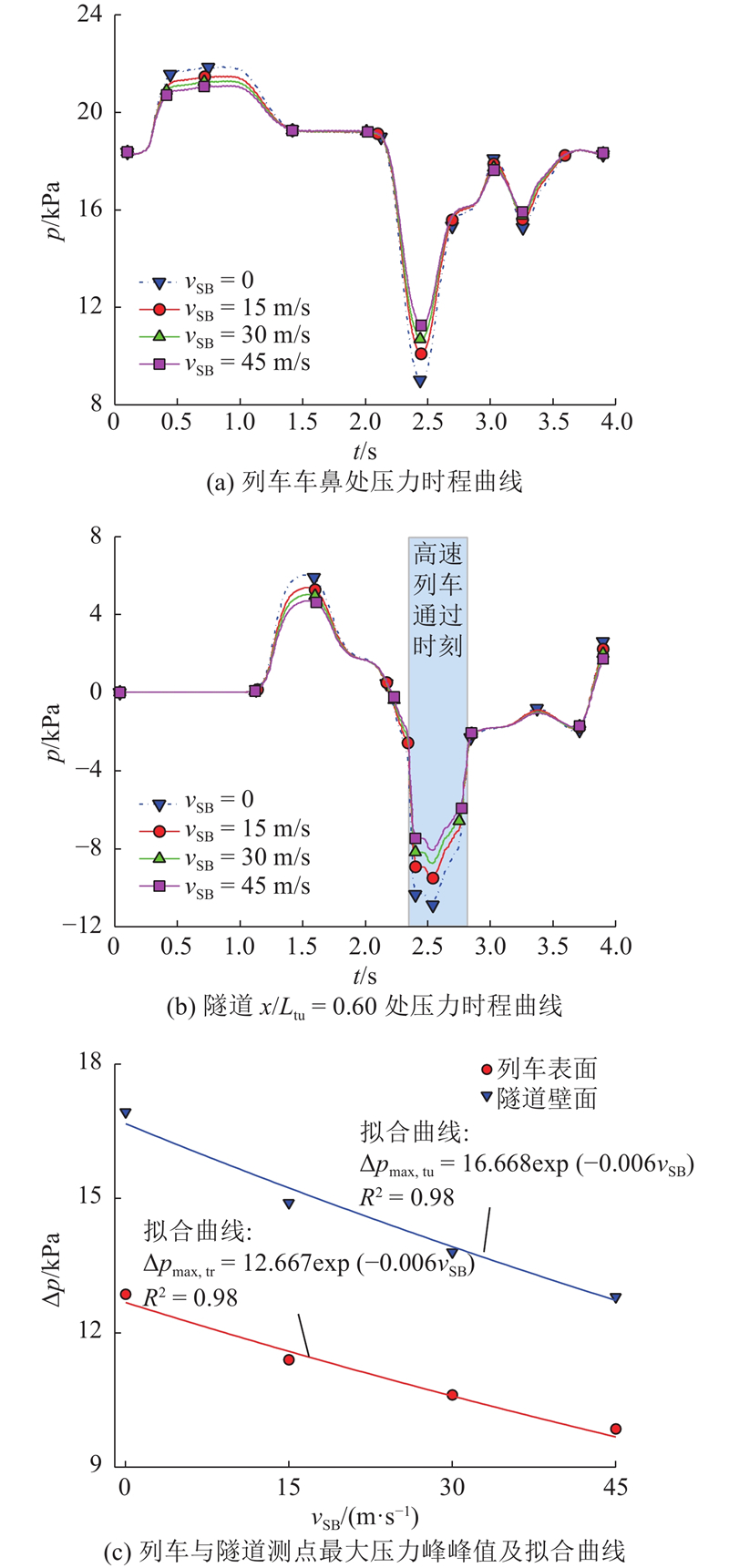
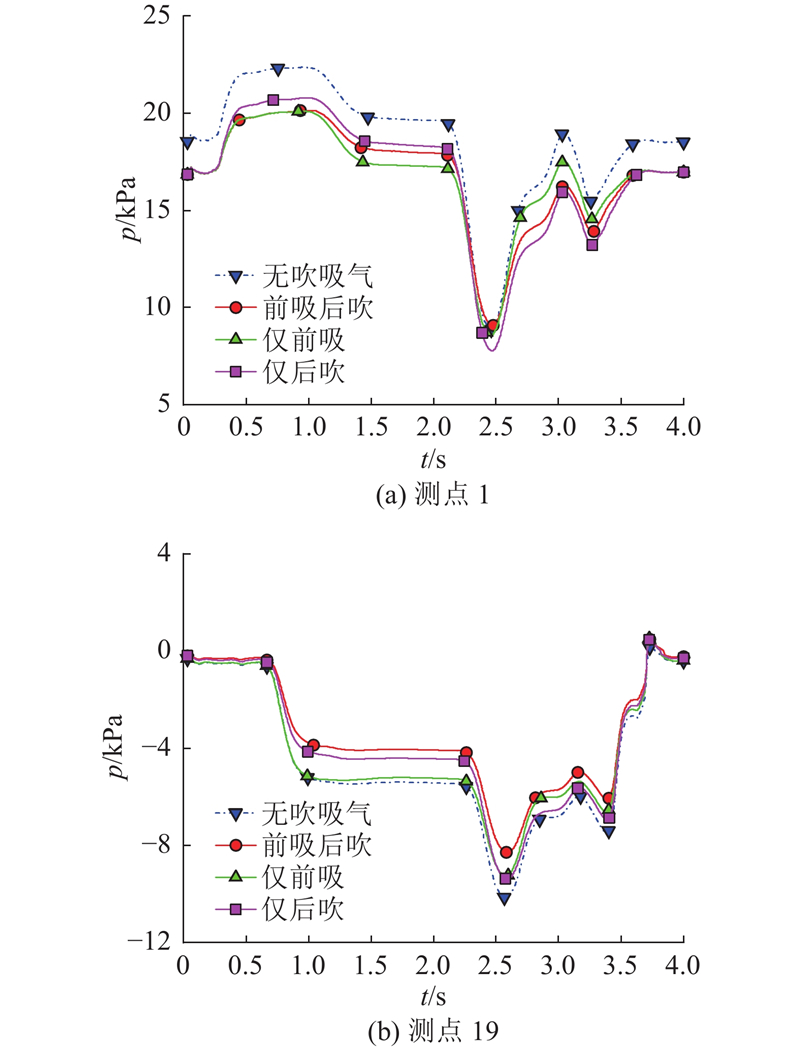
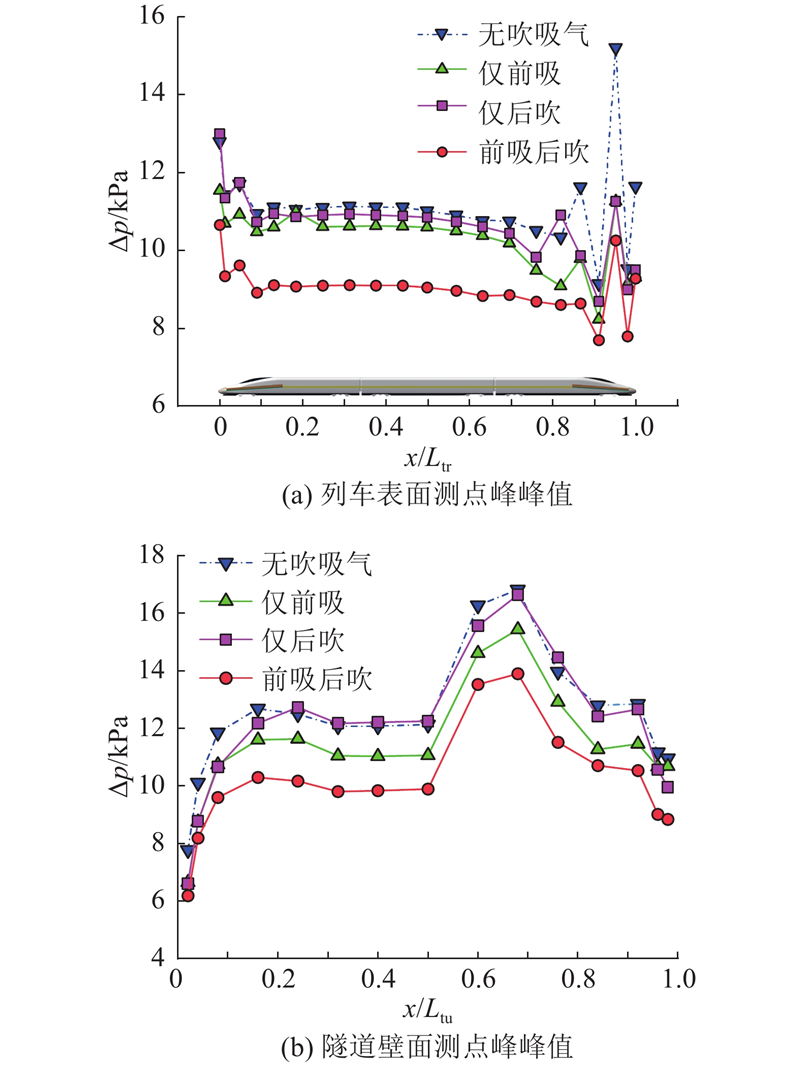
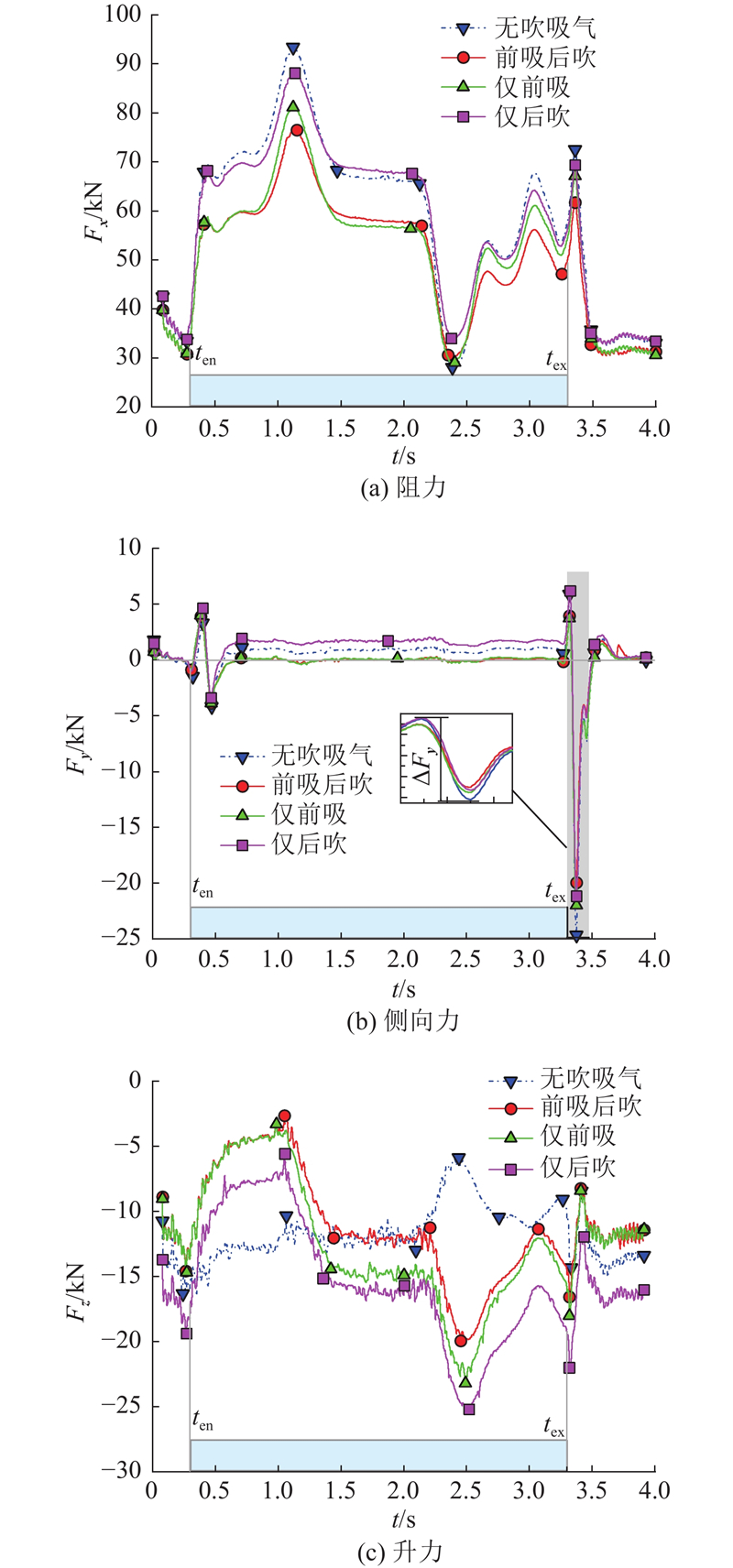
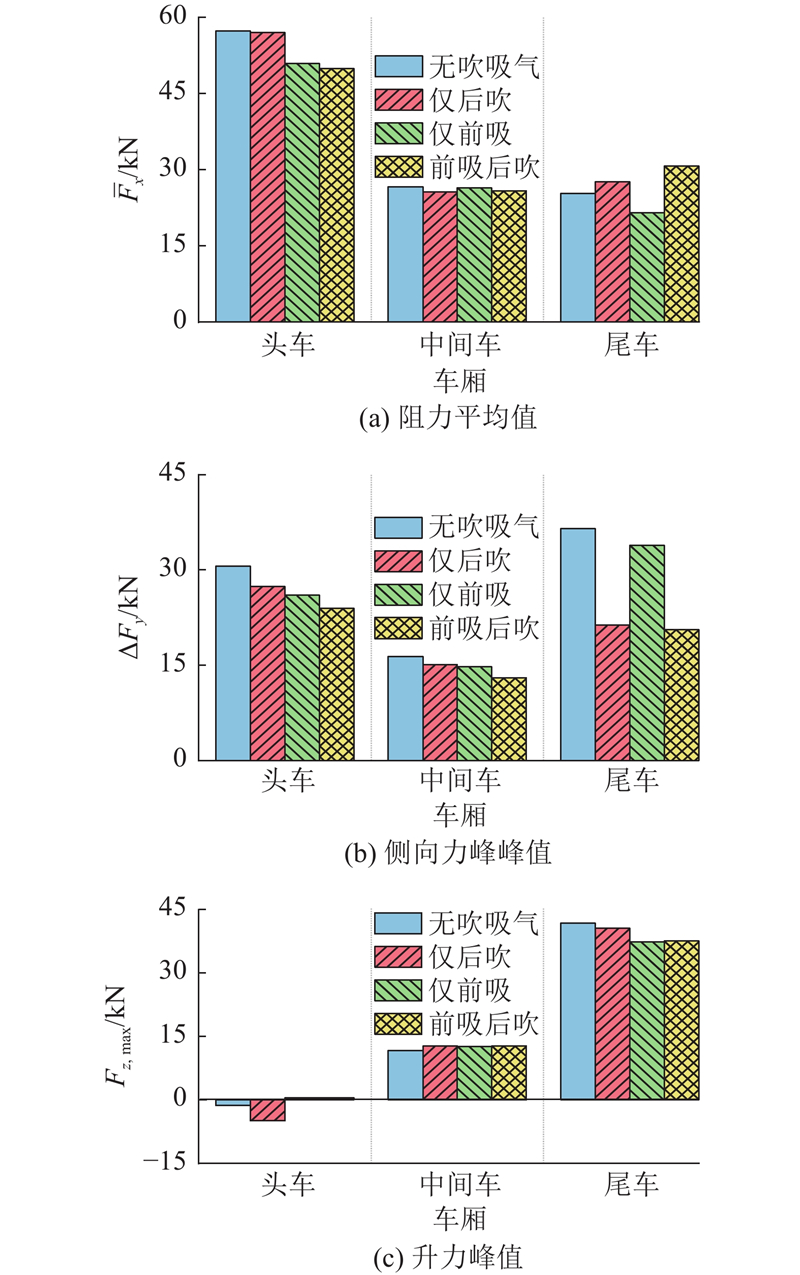
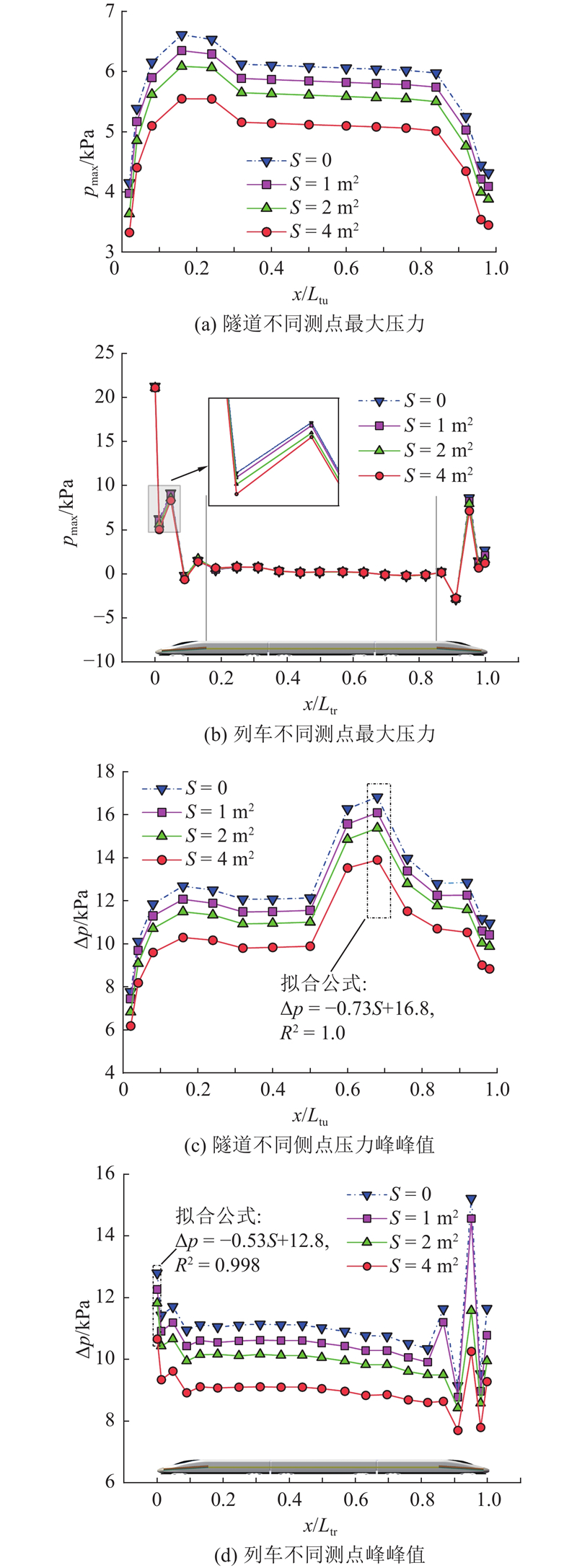
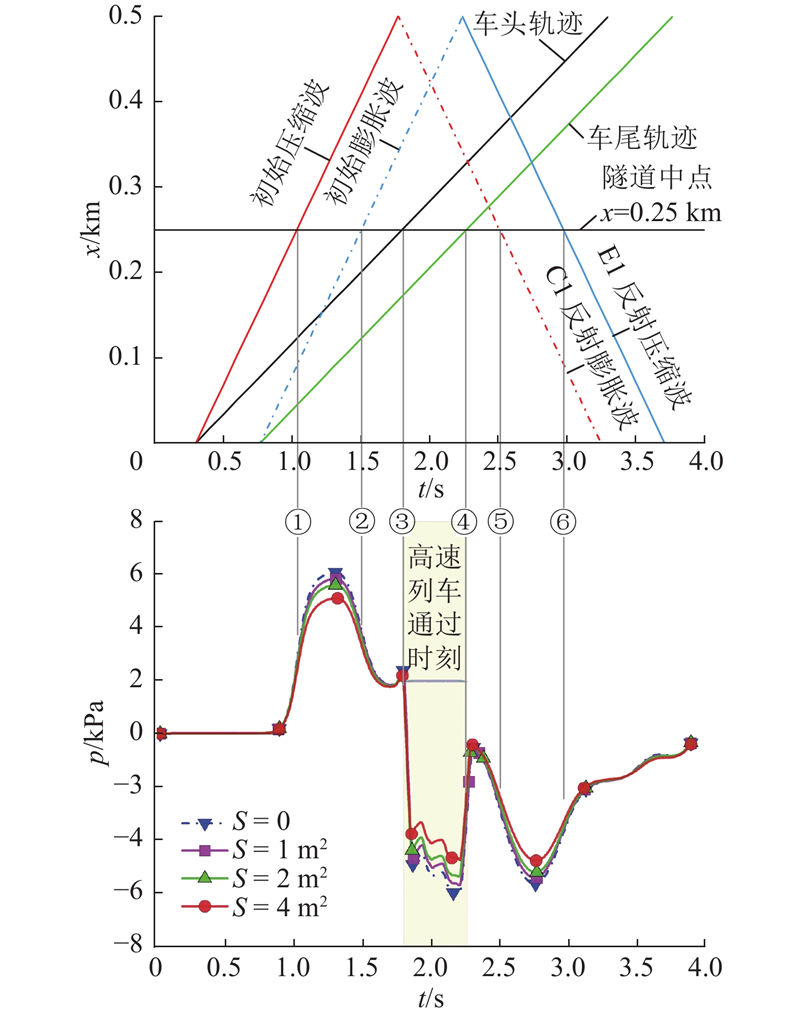
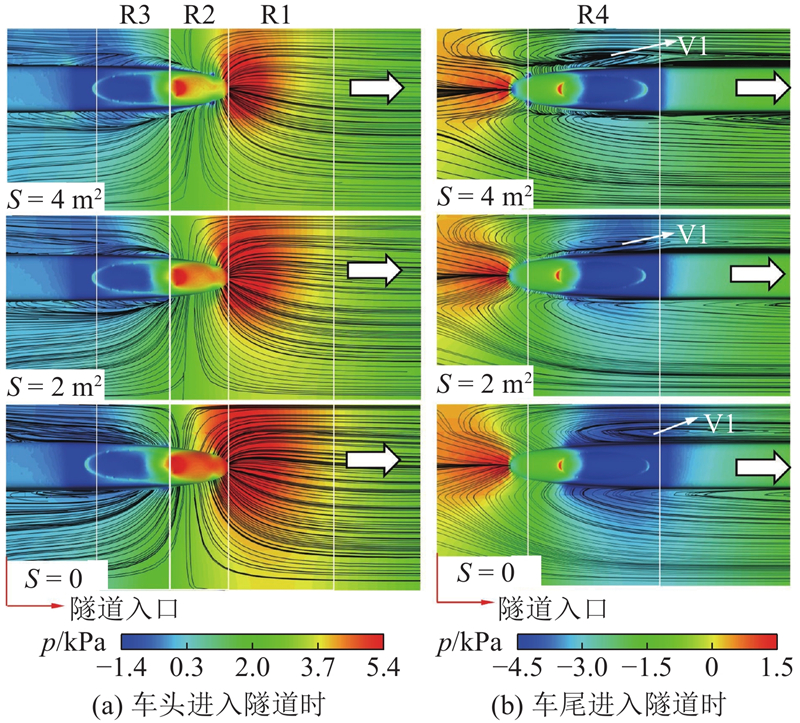
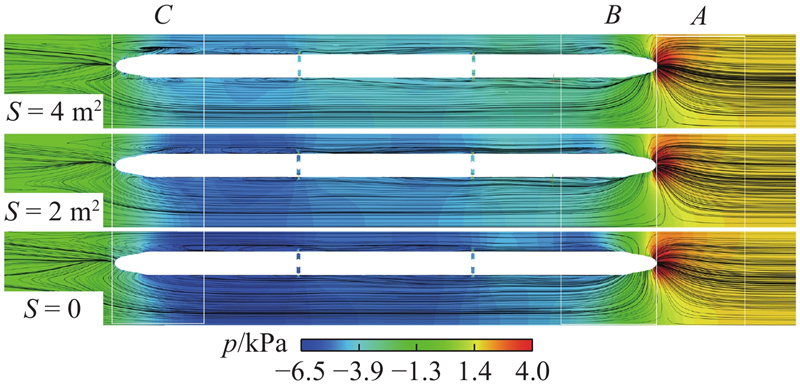
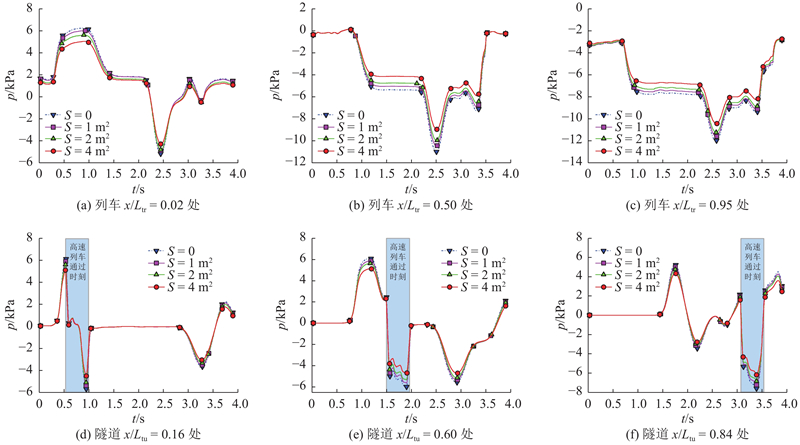
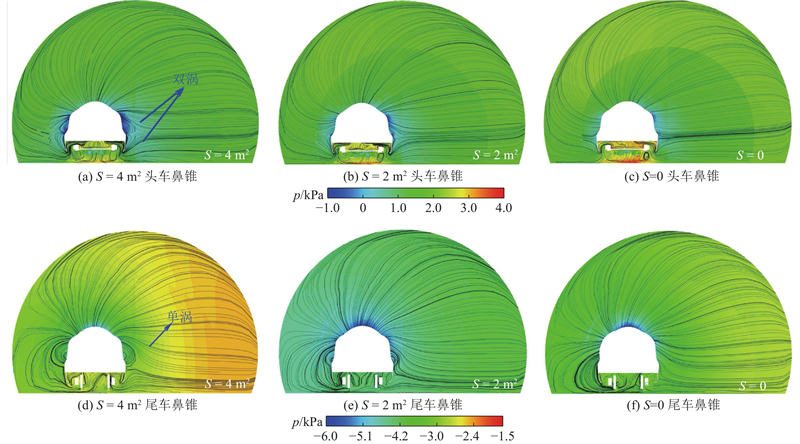
Abstract An active flow control strategy based on onboard blowing and suction was proposed to mitigate the aerodynamic effects induced by ultra-high-speed trains entering tunnels. A three-dimensional, compressible, and unsteady Reynolds-averaged Navier-Stokes (URANS) numerical model was established to analyze train-tunnel aerodynamic responses, including pressure waves and aerodynamic loads, under three control modes (front suction with rear blowing, front suction only, and rear blowing only) and different slit areas. Results demonstrate that the combined front suction and rear blowing mode significantly attenuates pressure fluctuations on both the train surface and tunnel wall, with an average peak-to-peak pressure reduction of 18%, outperforming the single modes. Specifically, front suction weakens the head compression wave and suppresses the positive pressure region ahead of the train, thereby effectively reducing the initial pressure gradient. Meanwhile, rear blowing alleviates the tail expansion wave and negative-pressure region, which helps improve flow stability. The peak-to-peak pressure control effect exhibits an approximately linear decay relationship with the blowing/suction slit area: when the slit area is 4 m2, the maximum pressure difference peak-to-peak values on the train and tunnel are reduced by about 16.6% and 17.4%, respectively. The proposed strategy simultaneously weakens the compression wave generated at the train head and the expansion wave generated at the train tail, thereby reducing pressure fluctuations on the train surface and tunnel wall as well as aerodynamic loads on the train body. Moreover, increasing the slit area can further enhance the attenuation of pressure waves.
|
|
Received: 03 September 2025
Published: 16 October 2026
|
|
|
| Fund: 江苏省自然科学基金资助项目(BK20240810);江苏省高校面上项目(24KJB580013). |
超高速列车隧道气动效应的主动吹/吸气控制策略
为了缓解超高速列车进入隧道时引起的空气动力学效应,提出基于车载吹/吸气的主动流动控制策略. 采用三维、可压缩和非定常雷诺时均纳维-斯托克斯(URANS)数值计算模型,分析前吸后吹、单独前吸和单独后吹3种模式及不同狭缝面积条件下的车隧气动响应规律(压力波和气动载荷). 结果表明:前吸后吹协同控制模式可显著削弱列车表面与隧道壁面瞬变压力,压力峰峰值平均降幅达18%,优于单一控制模式;前吸控制通过削弱车前压缩波及正压区,有效降低初始压力梯度;后吹控制缓解尾部膨胀波及负压区,对尾流稳定性改善明显;吹/吸狭缝面积与压力峰峰值控制效果呈近似线性衰减关系,当狭缝面积为4 m2时,列车与隧道最大压差峰值分别降低16.6%和17.4%. 所提策略通过同步削弱车头压缩波和车尾膨胀波,降低了列车表面压力波动、隧道壁面压力波动及车体气动载荷;增大狭缝面积可进一步增强压力波削弱效果.
关键词:
超高速列车,
铁路隧道,
主动流动控制,
隧道压力波,
气动载荷
|
|
| [1] |
RAGHUNATHAN R S, KIM H D, SETOGUCHI T Aerodynamics of high-speed railway train[J]. Progress in Aerospace Sciences, 2002, 38 (6/7): 469- 514
doi: 10.1036/1097-8542.yb031110
|
|
|
| [2] |
RICCO P, BARON A, MOLTENI P Nature of pressure waves induced by a high-speed train travelling through a tunnel[J]. Journal of Wind Engineering and Industrial Aerodynamics, 2007, 95 (8): 781- 808
doi: 10.1016/j.jweia.2007.01.008
|
|
|
| [3] |
KO Y Y, CHEN C H, HOE I T, et al Field measurements of aerodynamic pressures in tunnels induced by high speed trains[J]. Journal of Wind Engineering and Industrial Aerodynamics, 2012, 100 (1): 19- 29
|
|
|
| [4] |
KIM D H, SEO Y C, IYER R S, et al A newly designed entrance hood to reduce the micro pressure wave emitted from the exit of high-speed railway tunnel[J]. Tunnelling and Underground Space Technology, 2021, 108: 103728
|
|
|
| [5] |
LU Y, ZHANG D, ZHENG H, et al Analysis of the aerodynamic pressure effect on the fatigue strength of the carbody of high-speed trains passing by each other in a tunnel[J]. Proceedings of the Institution of Mechanical Engineers, Part F: Journal of Rail and Rapid Transit, 2019, 233 (8): 783- 801
|
|
|
| [6] |
XIE P, PENG Y, WANG T, et al Aural comfort prediction method for high-speed trains under complex tunnel environments[J]. Transportation Research Part D: Transport and Environment, 2020, 81: 102284
|
|
|
| [7] |
SRIVASTAVA S, SIVASANKAR G, DUA G A review of research into aerodynamic concepts for high speed trains in tunnels and open air and the air-tightness requirements for passenger comfort[J]. Proceedings of the Institution of Mechanical Engineers, Part F: Journal of Rail and Rapid Transit, 2022, 236 (9): 1011- 1025
|
|
|
| [8] |
YANG L, CHEN C, WANG X, et al Internal pressure fluctuation modelling and passenger pressure comfort analysis of high-speed trains passing through extreme tunnels[J]. Building and Environment, 2024, 251: 111200
|
|
|
| [9] |
HOWE M S, IIDA M, FUKUDA T Influence of an unvented tunnel entrance hood on the compression wave generated by a high-speed train[J]. Journal of Fluids and Structures, 2003, 17 (6): 833- 853
|
|
|
| [10] |
ZHANG J, GUO B, WANG Y, et al Influence of arch lattice-shell hood length on micro-pressure waves at portal of a high-speed maglev tunnel[J]. Physics of Fluids, 2024, 36 (9): 096105
|
|
|
| [11] |
OKUBO H, MIYACHI T, SUGIYAMA K Pressure fluctuation and a micro-pressure wave in a high-speed railway tunnel with large branch shaft[J]. Journal of Wind Engineering and Industrial Aerodynamics, 2021, 217: 104751
|
|
|
| [12] |
杨伟超, 王蔚雯, 李国志, 等 时速400 km高铁隧道洞口U型槽对微气压波的影响[J]. 铁道科学与工程学报, 2025, 22 (7): 2872- 2885
YANG Weichao, WANG Weiwen, LI Guozhi, et al Impact of U-shaped grooves at entrance of high-speed train tunnels on micro-pressure waves at speed of 400 km/h[J]. Journal of Railway Science and Engineering, 2025, 22 (7): 2872- 2885
|
|
|
| [13] |
LIN T T, YANG M Z, ZHANG L, et al Influence of bionics shark gills tunnel portal on the micro-pressure wave at the tunnel exit[J]. Tunnelling and Underground Space Technology, 2024, 144: 105542
|
|
|
| [14] |
韩嘉强, 马伟斌, 程爱君, 等 高速铁路长大隧道音爆现象及斜井辅助泄压缓解效果研究[J]. 中国铁道科学, 2024, 45 (3): 87- 96
HAN Jiaqiang, MA Weibin, CHENG Aijun, et al Research on sonic boom in long tunnels of high-speed railways and alleviation effect of auxiliary relief through inclined shaft[J]. China Railway Science, 2024, 45 (3): 87- 96
|
|
|
| [15] |
LI W, LIU T, HUO X, et al Influence of the enlarged portal length on pressure waves in railway tunnels with cross-section expansion[J]. Journal of Wind Engineering and Industrial Aerodynamics, 2019, 190: 10- 22
|
|
|
| [16] |
WILSON J, SCHATZMAN D, ARAD E, et al Suction and pulsed-blowing flow control applied to an axisymmetric body[J]. AIAA Journal, 2013, 51 (10): 2432- 2446
|
|
|
| [17] |
SCHATZMAN D, WILSON J, ARAD E, et al Drag-reduction mechanisms of suction-and-oscillatory-blowing flow control[J]. AIAA Journal, 2014, 52 (11): 2491- 2505
|
|
|
| [18] |
CUI H, CHEN G, GUAN Y, et al Study on aerodynamic drag reduction at tail of 400 km/h EMU with air suction-blowing combination[J]. Machines, 2023, 11 (2): 222
|
|
|
| [19] |
CHE Z X, HUANG S, LI Z W, et al Aerodynamic drag reduction of high-speed maglev train based on air blowing/suction[J]. Journal of Wind Engineering and Industrial Aerodynamics, 2023, 233: 105321
|
|
|
| [20] |
CHE Z X, CHEN Z W, NI Y Q, et al Research on the impact of air-blowing on aerodynamic drag reduction and wake characteristics of a high-speed maglev train[J]. Physics of Fluids, 2023, 35 (11): 115138
|
|
|
| [21] |
CHEN Z W, ZENG G Z, NI Y Q, et al Reducing the aerodynamic drag of high-speed trains by air blowing from the nose part: effect of blowing speed[J]. Journal of Wind Engineering and Industrial Aerodynamics, 2023, 238: 105429
|
|
|
| [22] |
GUO Z J, GUO Z H, CHEN Z W, et al On the active flow control in maglev train safety under crosswinds: analysis of leeward suction and blowing action[J]. Physics of Fluids, 2024, 36 (9): 095130
|
|
|
| [23] |
SUZUKI M, NAKADE K A basic study on countermeasure against aerodynamic force acting on train running inside tunnel using air blowing[J]. Journal of Mechanical Systems for Transportation and Logistics, 2010, 3 (1): 92- 99
|
|
|
| [24] |
CHEN Z W, GUO Z J, CHE Z X, et al Evaluation of active leeward side air-blowing layout on the lateral aerodynamic performance of high-speed trains in crosswinds environment: sustainable and safe operation strategy[J]. Journal of Wind Engineering and Industrial Aerodynamics, 2024, 247: 105695
|
|
|
| [25] |
British Standards Institution. Railway applications—Aerodynamics—Part 5: Requirements and test procedures for aerodynamics in tunnels: EN 14067-5 [S]. London: British Standards Institution, 2018.
|
|
|
| [26] |
NEGRI S, TOMASINI G, ROCCHI D, et al Numerical assessment of train slipstream in tunnels: stochastic analysis from CFD data[J]. Journal of Wind Engineering and Industrial Aerodynamics, 2025, 264: 106130
|
|
|
| [27] |
WANG Y, YU Y, HAN S, et al A novel arch lattice-shell tunnel hood design for mitigating pressure wave characteristics during a high-speed maglev train passage through a tunnel at various train speeds[J]. Tunnelling and Underground Space Technology, 2026, 168: 107015
|
|
|
| [28] |
NIU J, ZHOU D, LIU F, et al Effect of train length on fluctuating aerodynamic pressure wave in tunnels and method for determining the amplitude of pressure wave on trains[J]. Tunnelling and Underground Space Technology, 2018, 80: 277- 289
|
|
|
| [29] |
LI W, LIU T, MARTINEZ-VAZQUEZ P, et al Aerodynamic effects of a high-speed train travelling through adjoining and separated tunnels[J]. Tunnelling and Underground Space Technology, 2021, 113: 103973
|
|
|
| [30] |
XIANG X T, XUE L P Tunnel hood effects on high speed train-tunnel compression wave[J]. Journal of Hydrodynamics, 2010, 22 (1): 897- 904
|
|
|
|
Viewed |
|
|
|
Full text
|
|
|
|
|
Abstract
|
|
|
|
|
Cited |
|
|
|
|
| |
Shared |
|
|
|
|
| |
Discussed |
|
|
|
|