|
|
|
| Role of e-fuels in deep decarbonization strategies for international shipping |
Xuan ZHANG1( ),Chao JIN2,*(),Jeffrey Dankwa AMPAH1,Jingyao LI2,Jie YANG2,Zhixiong HUANG1,Haifeng LIU1,3,Mingfa YAO1 |
1. State Key Laboratory of Engines, Tianjin University, Tianjin 300072, China
2. School of Environmental Science and Engineering, Tianjin University, Tianjin 300350, China
3. School of Mechanical Engineering, Guangxi University, Nanning 530004, China |
|
|
|
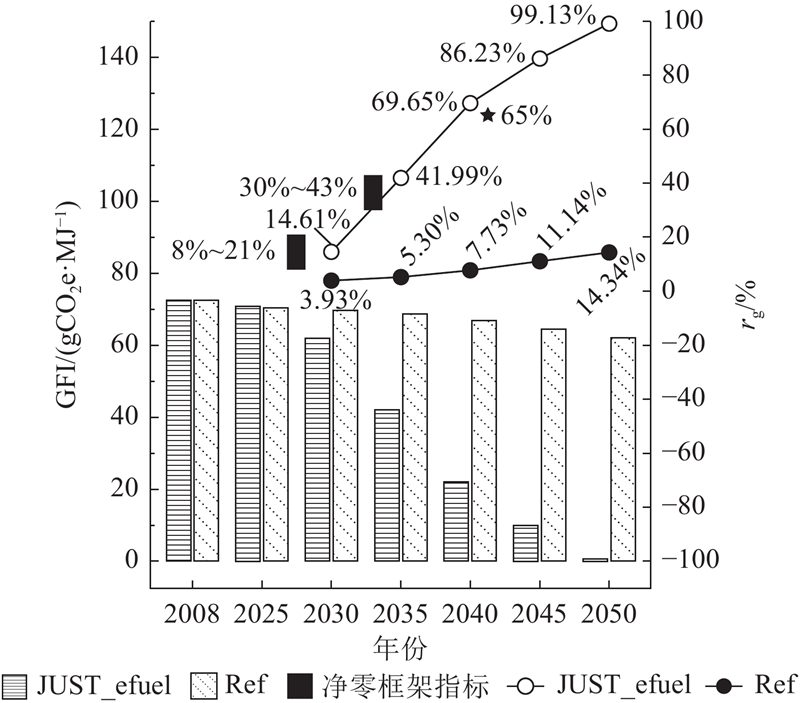
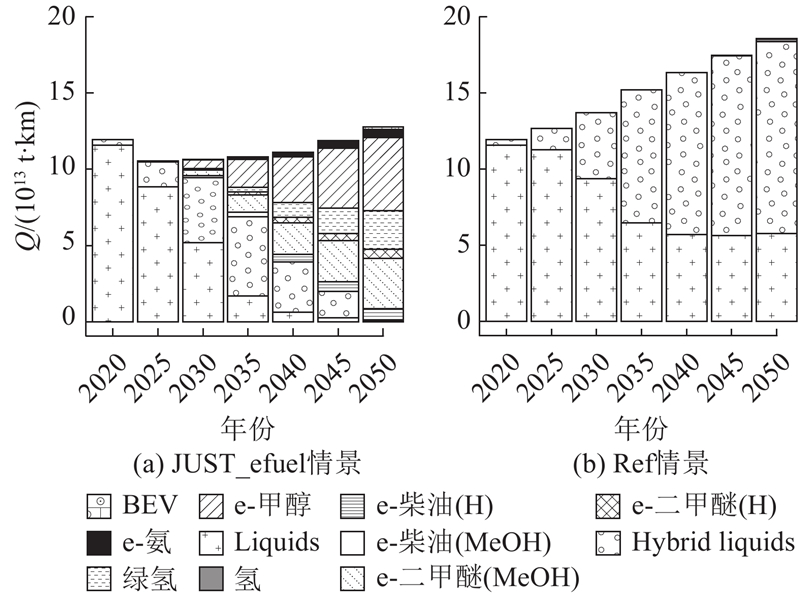
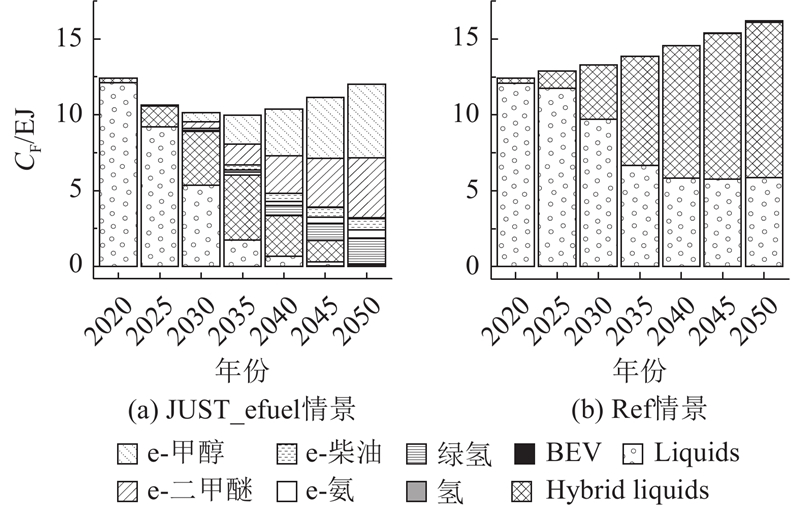
Abstract The role of e-fuels in achieving net-zero emissions in international shipping by 2050 and their impacts on the global energy–land–water system were evaluated. An integrated supply-chain module linking renewable electricity, green hydrogen production, carbon sources, synthesis of multiple e-fuels, and end-use sectors was developed based on the global change analysis model (GCAM). A reference scenario and a JUST-efuel scenario were constructed and compared. The results show that decarbonization in international shipping is driven by e-fuels through three pathways: altering the fuel structure, reducing fuel emissions intensity, and decreasing service demand. By 2040, e-fuels become the dominant shipping fuel, and shipping service demand in 2050 is approximately 33.3% lower than in the reference scenario. The supply of e-fuels exhibits a diversified pattern: with green hydrogen at its core, followed by e-methanol and e-dimethyl ether as key supplements, while e-ammonia and e-diesel maintain relatively minor shares. The deployment of e-fuels reshapes the hydrogen supply structure: green-electricity-based hydrogen production rapidly becomes dominant after 2035, thereby driving an increase in renewable power generation. Additionally, this pathway may reduce reliance on biomass and alleviate competition for land, water and agricultural resources. Overall, e-fuels not only provide a feasible solution for deep decarbonization in international shipping but also offer important pathways for the synergistic transformation of energy, transportation, and environmental systems. Nonetheless, this transition still relies on sufficient clean power supply and integrated cross-sectoral planning.
|
|
Received: 19 December 2025
Published: 16 October 2026
|
|
|
| Fund: 国家自然科学基金国际(地区)合作与交流项目(22461142138). |
|
Corresponding Authors:
Chao JIN
E-mail: xuan_zhang@tju.edu.cn;jinchao@tju.edu.cn
|
e-fuels助力国际航运深度脱碳的策略
评估e-fuels在实现国际航运到2050年净零排放中的作用及其对全球能源—土地—水系统的影响. 基于全球变化评估模型(GCAM),构建“可再生电力—绿氢—碳源—多类e-fuels合成—终端消费部门”的全链条模块,设置基准情景与JUST-efuel情景进行对比分析. 结果表明,e-fuels通过优化燃料结构、降低燃料排放强度与减少服务需求这3条路径推动国际航运脱碳;e-fuels至2040年成为主导燃料,2050年航运服务需求较基准情景下降约33.3%. e-fuels供应呈现多元化特征,以绿氢为核心,e-甲醇和e-二甲醚作为主要补充,e-氨与e-柴油占比较低. e-fuels的部署将推动制氢供应结构的转变,绿电制氢自2035年后迅速占优,拉动可再生能源发电量的提升;该部署能够降低对生物质依赖,缓解对土地、水与农业资源的竞争. e-fuels不仅为国际航运深度脱碳提供了可行方案,也为能源—交通—环境系统的协同转型提供了重要路径. 实现该转型依赖于大规模清洁电力供应与跨部门系统规划.
关键词:
e-fuels,
国际航运,
绿电,
深度脱碳,
净零排放
|
|
| [1] |
UNCTAD, Division on Technology and Logistics, Trade Logistics Branch. Review of maritime transport 2022: navigating stormy waters [R]. Geneva: United Nations, 2022.
|
|
|
| [2] |
International Energy Agency. CO2 emissions in 2023 [R/OL]. [2025–06–08]. https://iea.blob.core.windows.net/assets/33e2badc-b839-4c18-84ce-f6387b3c008f/CO2Emissionsin2023.pdf.
|
|
|
| [3] |
范欣宇. 国际海事组织净零框架——全球航运减排的里程碑[EB/OL]. (2025–05–06) [2026–02–19]. https://iigf.cufe.edu.cn/info/1012/9884.htm.
|
|
|
| [4] |
SCIBERRAS E A, ZAHAWI B, ATKINSON D J Reducing shipboard emissions: Assessment of the role of electrical technologies[J]. Transportation Research Part D: Transport and Environment, 2017, 51: 227- 239
doi: 10.1016/j.trd.2016.10.026
|
|
|
| [5] |
KIM K, PARK K, LEE J, et al Analysis of battery/generator hybrid container ship for CO2 reduction[J]. IEEE Access, 2018, 6: 14537- 14543
doi: 10.1109/ACCESS.2018.2814635
|
|
|
| [6] |
DERE C, DENIZ C Effect analysis on energy efficiency enhancement of controlled cylinder liner temperatures in marine diesel engines with model based approach[J]. Energy Conversion and Management, 2020, 220: 113015
doi: 10.1016/j.enconman.2020.113015
|
|
|
| [7] |
MALOBERTI L, ZACCONE R An environmentally sustainable energy management strategy for marine hybrid propulsion[J]. Energy, 2025, 316: 134517
doi: 10.1016/j.energy.2025.134517
|
|
|
| [8] |
卢明剑, 董胜节, 严新平, 等 船舶碳捕集、利用与封存技术综述[J]. 交通运输工程学报, 2024, 24 (2): 1- 19
LU Mingjian, DONG Shengjie, YAN Xinping, et al Review on ship-based carbon capture, utilization and sequestration technology[J]. Journal of Traffic and Transportation Engineering, 2024, 24 (2): 1- 19
doi: 10.19818/j.cnki.1671-1637.2024.02.001
|
|
|
| [9] |
Det Norske Veritas. The potential of onboard carbon capture in shipping [R/OL]. [2026–02–18]. https://www.dnv.com/maritime/publications/.
|
|
|
| [10] |
TOMOS B A D, STAMFORD L, WELFLE A, et al Decarbonising international shipping: a life cycle perspective on alternative fuel options[J]. Energy Conversion and Management, 2024, 299: 117848
doi: 10.1016/j.enconman.2023.117848
|
|
|
| [11] |
AMPAH J D, YUSUF A A, AFRANE S, et al Reviewing two decades of cleaner alternative marine fuels: towards IMO’s decarbonization of the maritime transport sector[J]. Journal of Cleaner Production, 2021, 320: 128871
doi: 10.1016/j.jclepro.2021.128871
|
|
|
| [12] |
BERGERO C, GOSNELL G, GIELEN D, et al Pathways to net-zero emissions from aviation[J]. Nature Sustainability, 2023, 6 (4): 404- 414
doi: 10.1038/s41893-022-01046-9
|
|
|
| [13] |
GALIMOVA T, RAM M, BOGDANOV D, et al Global trading of renewable electricity-based fuels and chemicals to enhance the energy transition across all sectors towards sustainability[J]. Renewable and Sustainable Energy Reviews, 2023, 183: 113420
doi: 10.1016/j.rser.2023.113420
|
|
|
| [14] |
International Energy Agency. Renewables 2022 [R/OL]. [2025–05–16]. https://iea.blob.core.windows.net/assets/ada7af90-e280-46c4-a577-df2e4fb44254/Renewables2022.pdf.
|
|
|
| [15] |
NEMMOUR A, INAYAT A, JANAJREH I, et al Green hydrogen-based e-fuels (e-methane, e-methanol, e-ammonia) to support clean energy transition: a literature review[J]. International Journal of Hydrogen Energy, 2023, 48 (75): 29011- 29033
doi: 10.1016/j.ijhydene.2023.03.240
|
|
|
| [16] |
ALI S A, AHMAD BANGASH I, SAJJAD H, et al Review on the role of electrofuels in decarbonizing hard-to-abate transportation sectors: advances, challenges, and future directions[J]. Energy and Fuels, 2025, 39 (11): 5051- 5098
doi: 10.1021/acs.energyfuels.4c06185
|
|
|
| [17] |
VARONE A, FERRARI M Power to liquid and power to gas: an option for the German energiewende[J]. Renewable and Sustainable Energy Reviews, 2015, 45: 207- 218
doi: 10.1016/j.rser.2015.01.049
|
|
|
| [18] |
HEPBURN C, ADLEN E, BEDDINGTON J, et al The technological and economic prospects for CO2 utilization and removal[J]. Nature, 2019, 575 (7781): 87- 97
doi: 10.1038/s41586-019-1681-6
|
|
|
| [19] |
MURATORI M, SMITH S J, KYLE P, et al Role of the freight sector in future climate change mitigation scenarios[J]. Environmental Science and Technology, 2017, 51 (6): 3526- 3533
doi: 10.1021/acs.est.6b04515
|
|
|
| [20] |
SPEIZER S, FUHRMAN J, ALDRETE LOPEZ L, et al Integrated assessment modeling of a zero-emissions global transportation sector[J]. Nature Communications, 2024, 15: 4439
doi: 10.1038/s41467-024-48424-9
|
|
|
| [21] |
MARTIN J, DIMANCHEV E, NEUMANN A Carbon abatement costs for renewable fuels in hard-to-abate transport sectors[J]. Advances in Applied Energy, 2023, 12: 100156
doi: 10.1016/j.adapen.2023.100156
|
|
|
| [22] |
International Energy Agency. Electricity mid-year update 2025 [R/OL]. [2025–04–24]. https://iea.blob.core.windows.net/assets/cc64f0aa-30e4-4497-9cca-1ffae2c55fe5/ElectricityMid-YearUpdate2025.pdf.
|
|
|
| [23] |
KANY M S, MATHIESEN B V, SKOV I R, et al Energy efficient decarbonisation strategy for the Danish transport sector by 2045[J]. Smart Energy, 2022, 5: 100063
doi: 10.1016/j.segy.2022.100063
|
|
|
| [24] |
KORBERG A D, BRYNOLF S, GRAHN M, et al Techno-economic assessment of advanced fuels and propulsion systems in future fossil-free ships[J]. Renewable and Sustainable Energy Reviews, 2021, 142: 110861
doi: 10.1016/j.rser.2021.110861
|
|
|
| [25] |
KANCHIRALLA F M, BRYNOLF S, MJELDE A Role of biofuels, electro-fuels, and blue fuels for shipping: environmental and economic life cycle considerations[J]. Energy and Environmental Science, 2024, 17 (17): 6393- 6418
doi: 10.1039/D4EE01641F
|
|
|
| [26] |
Joint Global Change Research Institute. Global change analysis model (GCAM) [EB/OL]. [2026–02–12]. https://github.com/JGCRI/gcam-core.
|
|
|
| [27] |
CLARKE J F, EDMONDS J A Modelling energy technologies in a competitive market[J]. Energy Economics, 1993, 15 (2): 123- 129
doi: 10.1016/0140-9883(93)90031-l
|
|
|
| [28] |
薛树业 “国际海事组织净零框架规则”草案解析[J]. 世界海运, 2025, 48 (6): 21- 29
XUE Shuye Analysis of the draft “IMO Net-Zero Framework Rules”[J]. World Shipping, 2025, 48 (6): 21- 29
doi: 10.16176/j.cnki.21-1284.2025.06.004
|
|
|
| [29] |
童亮, 袁裕鹏, 李骁, 等 我国氢动力船舶创新发展研究[J]. 中国工程科学, 2022, 24 (3): 127- 139
TONG Liang, YUAN Yupeng, LI Xiao, et al Innovative developmental of hydrogen-powered ships in China[J]. Strategic Study of CAE, 2022, 24 (3): 127- 139
doi: 10.15302/J-SSCAE-2022.03.014
|
|
|
| [30] |
ZHOU X, LI T, WANG N, et al Pilot diesel-ignited ammonia dual fuel low-speed marine engines: a comparative analysis of ammonia premixed and high-pressure spray combustion modes with CFD simulation[J]. Renewable and Sustainable Energy Reviews, 2023, 173: 113108
doi: 10.1016/j.rser.2022.113108
|
|
|
| [31] |
WEN M, LIU H, ZHANG S, et al A study of ammonia combustion induced by high reactivity fuel based on optical diagnostics and chemical kinetic analyses[J]. Combustion and Flame, 2025, 272: 113896
doi: 10.1016/j.combustflame.2024.113896
|
|
|
| [32] |
NIE X, BI Y, SHEN L, et al Combustion and emission characteristics of ammonia-diesel dual fuel engine at different altitudes[J]. Fuel, 2024, 371: 132072
doi: 10.1016/j.fuel.2024.132072
|
|
|
| [33] |
VERHELST S, TURNER J W, SILEGHEM L, et al Methanol as a fuel for internal combustion engines[J]. Progress in Energy and Combustion Science, 2019, 70: 43- 88
doi: 10.1016/j.pecs.2018.10.001
|
|
|
| [34] |
MOIRANGTHEM K. Alternative fuels for marine and inland waterways [M]. [S.l.]: Publications Office of the European Union, 2016.
|
|
|
| [35] |
中国船级社. 航运低碳发展展望2023 [R]. 北京: 中国船级社, 2023.
|
|
|
| [36] |
HUANG Z, ZHANG W, HAN D, et al Dimethyl ether: a promising fuel for marine engines[J]. Frontiers in Energy, 2025, 19 (1): 28- 32
doi: 10.1007/s11708-025-0986-4
|
|
|
| [37] |
LEBLANC S, YU X, WANG L, et al. Dimethyl ether to power next-generation road transportation [J]. International Journal of Automotive Manufacturing and Materials, 2023: 3.
|
|
|
| [38] |
SORENSON S C, MIKKELSEN S E Performance and emissions of a 0.273 liter direct injection diesel engine fuelled with neat dimethyl ether[J]. SAE Technical Paper Series, 1995, 1: 950064
doi: 10.4271/950064
|
|
|
| [39] |
FLEISCH T, MCCARTHY C, BASU A, et al A new clean diesel technology: demonstration of ULEV emissions on a navistar diesel engine fueled with dimethyl ether[J]. SAE Technical Paper Series, 1995, 1: 950061
doi: 10.4271/950061
|
|
|
| [40] |
FLEISCH T H, BASU A, GRADASSI M J, et al Dimethyl ether: a fuel for the 21st century[J]. Studies in Surface Science and Catalysis, 1997, 107: 117- 125
|
|
|
| [41] |
ZHANG J, HUANG Z, HAN D Exergy losses in auto-ignition processes of DME and alcohol blends[J]. Fuel, 2018, 229: 116- 125
doi: 10.1016/j.fuel.2018.04.162
|
|
|
| [42] |
LI Z, WANG W, HUANG Z, et al Dimethyl ether autoignition at engine-relevant conditions[J]. Energy and Fuels, 2013, 27 (5): 2811- 2817
doi: 10.1021/ef400293z
|
|
|
| [43] |
ZHANG J, QIAO X, WANG Z, et al Experimental investigation of low-temperature combustion (LTC) in an engine fueled with dimethyl ether (DME)[J]. Energy and Fuels, 2009, 23 (1): 170- 174
doi: 10.1021/ef800674s
|
|
|
| [44] |
SOUISSI N. E-diesel in the shipping sector: prospects and challenges [M/OL]. [2026–02–19]. https://www.oxfordenergy.org/wpcms/wp-content/uploads/2024/03/ET30-E-diesel-in-the-Shipping-Sector-Final_NS.pdf.
|
|
|
| [45] |
UECKERDT F, BAUER C, DIRNAICHNER A, et al Potential and risks of hydrogen-based e-fuels in climate change mitigation[J]. Nature Climate Change, 2021, 11 (5): 384- 393
doi: 10.1038/s41558-021-01032-7
|
|
|
| [46] |
MÜLLER L J, KÄTELHÖN A, BACHMANN M, et al A guideline for life cycle assessment of carbon capture and utilization[J]. Frontiers in Energy Research, 2020, 8: 15
doi: 10.3389/fenrg.2020.00015
|
|
|
| [47] |
LACERDA DE OLIVEIRA CAMPOS B, JOHN K, BEESKOW P, et al A detailed process and techno-economic analysis of methanol synthesis from H2 and CO2 with intermediate condensation steps[J]. Processes, 2022, 10 (8): 1535
|
|
|
| [48] |
POTO S, VINK T, OLIVER P, et al Techno-economic assessment of the one-step CO2 conversion to dimethyl ether in a membrane-assisted process[J]. Journal of CO2 Utilization, 2023, 69: 102419
|
|
|
| [49] |
The Hydrogen Energy. e-fuels: technologies, innovations, efficiency, usage, and cost comparison, all you need to know [EB/OL]. [2025–09–21]. https://thehydrogen.energy/e-fuels/an-in-depth-look-at-efuels-technologies-innovations-efficiency-usage-and-cost-comparison/.
|
|
|
| [50] |
GIERSE M, KERSCHBAUM M, STEINBACH B, et al Optimized design and techno-economic analysis of novel DME production processes[J]. Reaction Chemistry and Engineering, 2023, 8 (11): 2826- 2840
doi: 10.1039/D3RE00333G
|
|
|
| [51] |
BUBE S, VOß S, QUANTE G, et al Cost analysis of kerosene production from power-based syngas via the Fischer-Tropsch and methanol pathway[J]. Fuel, 2025, 384: 133901
doi: 10.1016/j.fuel.2024.133901
|
|
|
|
Viewed |
|
|
|
Full text
|
|
|
|
|
Abstract
|
|
|
|
|
Cited |
|
|
|
|
| |
Shared |
|
|
|
|
| |
Discussed |
|
|
|
|