|
|
|
| Comparative assessment of life-cycle environmental impact of fly ash disposal technology |
Shuping PAN1( ),Yuhao LUO1,Shun’an XU2,Bingqian QUAN1,Wei LI3,Sujing LI3,Kexuan YANG1,*() ),Yuhao LUO1,Shun’an XU2,Bingqian QUAN1,Wei LI3,Sujing LI3,Kexuan YANG1,*() |
1. Zhejiang Province Ecological Environmental Monitoring Centre, Hangzhou 310012, China
2. Zhejiang Environmental Monitoring Engineering Limited Company, Hangzhou 310018, China
3. College of Chemical and Biological Engineering, Zhejiang University, Hangzhou 310058, China |
|
|
|
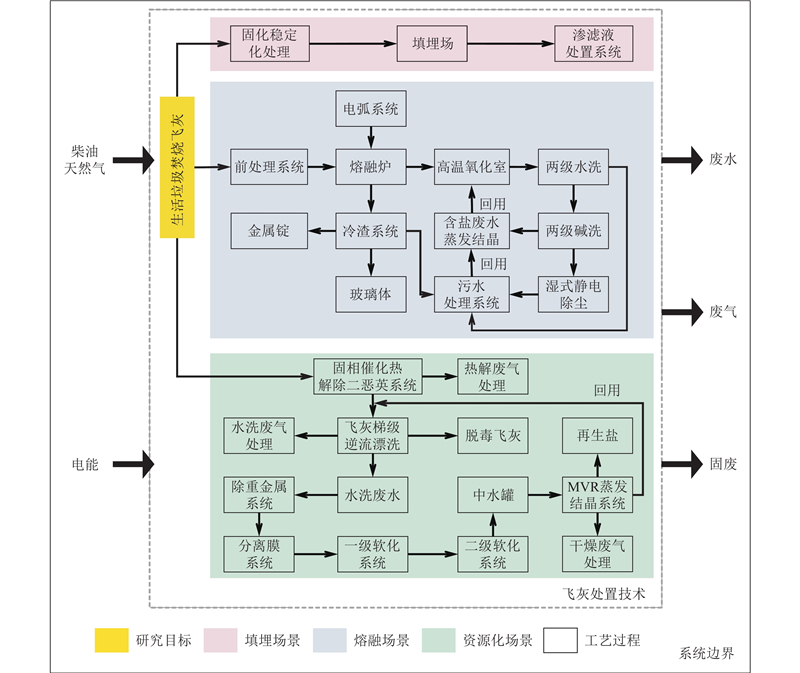
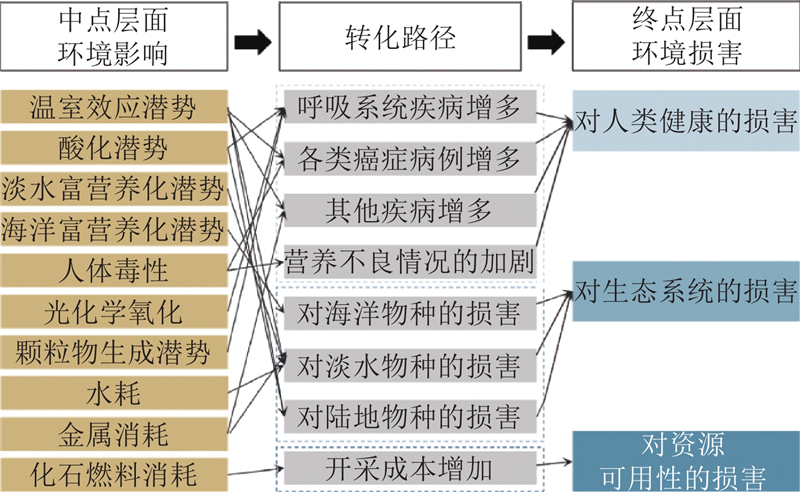
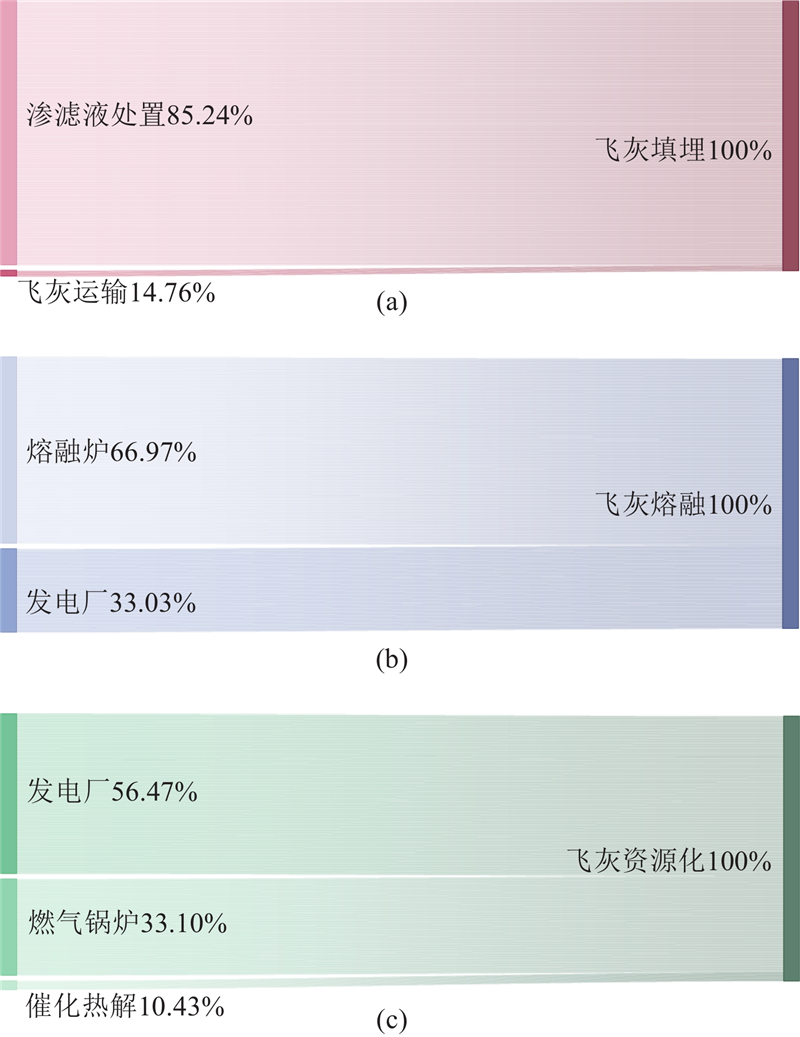
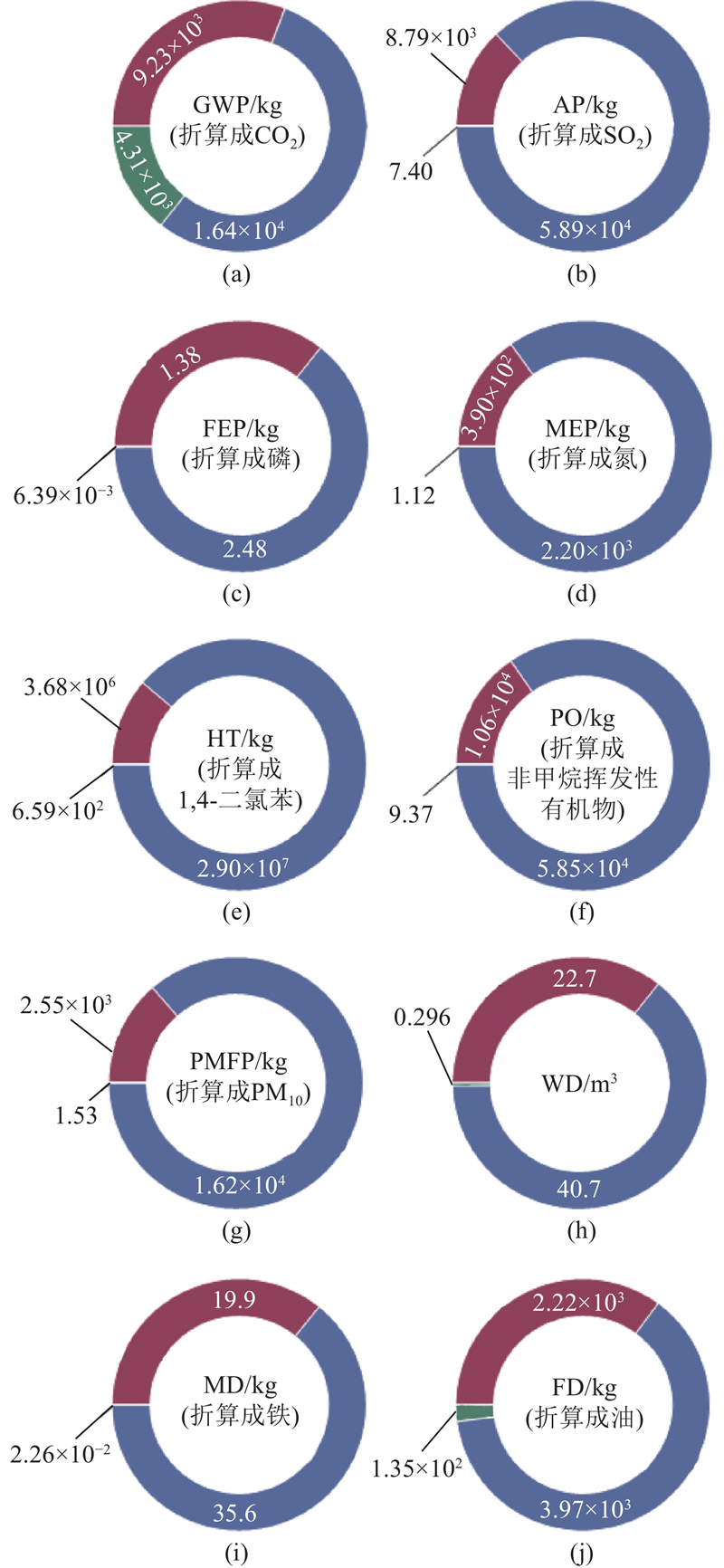
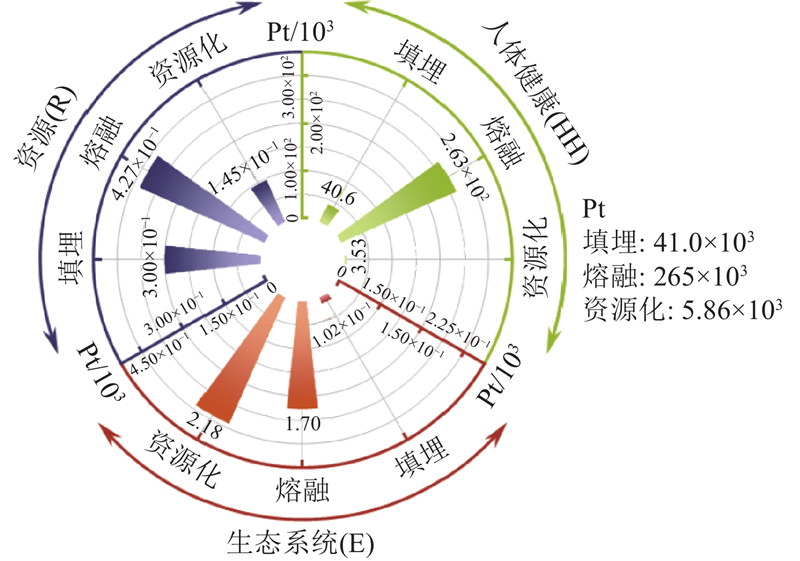
Abstract A comparative assessment of life-cycle environmental impact was conducted for three disposal methods of municipal solid waste (MSW) incineration fly ash, including landfill, melting and resource utilization disposal. Ten midpoint impacts (including global warming potential (GWP), human toxocity (HT), etc) and three endpoint damages (human health, ecosystem, resource) were quantified. Results showed that 85.24% of landfill’s environmental burden stemmed from leachate treatment, while 66.97% of melting’s negative contribution came from fossil fuel consumption and heavy metal emission. The environmental impact of resource utilization technology was significantly lower than that of the other two technologies. GWP (4.31×10³ kg (converted into carbon dioxide)) was 26% of melting and 47% of landfill, and HT (659 kg (converted into 1,4-Dichlorobenzene)) was 99.98% lower than melting. Total ecological index (5.86×10³) was only 2.2% of melting, though energy consumption remained a bottleneck. Resource utilization disposal delivers superior environmental benefit, and promoting clean energy substitution is key to the green and sustainable transformation.
|
|
Received: 01 July 2025
Published: 06 May 2026
|
|
|
| Fund: 2022年度“领雁”研发攻关计划资助项目(2022C03056). |
|
Corresponding Authors:
Kexuan YANG
E-mail: panshuping@zjemc.org.cn;kexuan-yang@zju.edu.cn
|
飞灰处置技术的生命周期环境影响对比评估
针对城市生活垃圾(MSW)焚烧飞灰的填埋、熔融及资源化3种处置方式,开展生命周期环境影响的对比评估,量化全球变暖潜势(GWP)、人体毒性(HT)在内的10类中点影响以及人体健康、生态系统、资源3类终点损害. 结果表明,填埋85.24%的环境负荷源于渗滤液处理,熔融66.97%的负面贡献来自化石燃料消耗及重金属排放. 资源化技术的环境影响显著低于其他2种技术,GWP(4.31×10³ kg (折算成二氧化碳))仅为熔融的26%和填埋的47%,HT(659 kg(折算成1,4-二氯苯))较熔融降低99.98%. 总生态指数因子(5.86×10³)仅为熔融的2.2%,但能耗仍是主要瓶颈. 资源化技术的环境效益更显著,以清洁能源替代为抓手可推动绿色可持续转型.
关键词:
城市生活垃圾焚烧飞灰,
资源化利用,
生命周期评价(LCA),
人体毒性(HT),
不确定性分析
|
|
| [1] |
FANG B X, XIA F H, ZHAO M Q, et al Disposal of municipal solid waste incineration fly ash through synergistic in-plant dechlorination and sintering[J]. Journal of Environmental Management, 2025, 383: 125514
doi: 10.1016/j.jenvman.2025.125514
|
|
|
| [2] |
中华人民共和国国家统计局. 中国统计年鉴2024 [M]. 北京: 中国统计出版社, 2024.
|
|
|
| [3] |
International Energy Agency (IEA). World Energy Outlook 2024 [R]. Paris: IEA, 2024.
|
|
|
| [4] |
中华人民共和国国务院. 关于加快推进城镇环境基础设施建设的指导意见 [EB/OL]. (2022-01-12). https://www.gov.cn/gongbao/content/2022/content_5675952.htm.
|
|
|
| [5] |
中华人民共和国国务院. 2030年前碳达峰行动方案[EB/OL]. (2021-10-24). https://www.gov.cn/zhengce/content/2021-10/26/content_5644984.htm.
|
|
|
| [6] |
DOU X, REN F, NGUYEN M Q, et al Review of MSWI bottom ash utilization from perspectives of collective characterization, treatment and existing application[J]. Renewable and Sustainable Energy Reviews, 2017, 79: 24- 38
doi: 10.1016/j.rser.2017.05.044
|
|
|
| [7] |
XUE Y, LIU X M Detoxification, solidification and recycling of municipal solid waste incineration fly ash: a review[J]. Chemical Engineering Journal, 2021, 420 (3): 130349
|
|
|
| [8] |
WANG L, JIN Y Y, NIE Y F Investigation of accelerated and natural carbonation of MSWI fly ash with a high content of Ca[J]. Journal of Hazardous Materials, 2010, 174 (1-3): 334- 343
doi: 10.1016/j.jhazmat.2009.09.055
|
|
|
| [9] |
ZHANG Z, ZHAO C T, RAO Y, et al Solidification/stabilization and risk assessment of heavy metals in municipal solid waste incineration fly ash: a review[J]. Science of the Total Environment, 2023, 892: 164451
doi: 10.1016/j.scitotenv.2023.164451
|
|
|
| [10] |
MAO Y P, WU H, WANG W L, et al Pretreatment of municipal solid waste incineration fly ash and preparation of solid waste source sulphoaluminate cementitious material[J]. Journal of Hazardous Materials, 2020, 385: 121580
doi: 10.1016/j.jhazmat.2019.121580
|
|
|
| [11] |
中华人民共和国生态环境部. 国家危险废物名录(2025年版) [EB/OL]. (2024-11-26). https://www.mee.gov.cn/gzk/gz/202411/t20241129_1097688.shtml.
|
|
|
| [12] |
BISHOP G, STYLES D, LENS P N L Environmental performance comparison of bioplastics and petrochemical plastics: a review of life cycle assessment (LCA) methodological decisions[J]. Resources Conservation and Recycling, 2021, 168: 105451
doi: 10.1016/j.resconrec.2021.105451
|
|
|
| [13] |
SANJUAN-DELMAS D, ALVARENGA R A F, LINDBLOM M, et al Environmental assessment of copper production in Europe: an LCA case study from Sweden conducted using two conventional software-database setups[J]. International Journal of Life Cycle Assessment, 2022, 27 (2): 255- 266
doi: 10.1007/s11367-021-02018-5
|
|
|
| [14] |
SALA S, CRENNA E, SECCHI M, et al Environmental sustainability of European production and consumption assessed against planetary boundaries[J]. Journal of Environmental Management, 2020, 269: 110686
doi: 10.1016/j.jenvman.2020.110686
|
|
|
| [15] |
YADAV P, SAMADDER S R A critical review of the life cycle assessment studies on solid waste management in Asian countries[J]. Journal of Cleaner Production, 2018, 185: 492- 515
doi: 10.1016/j.jclepro.2018.02.298
|
|
|
| [16] |
HUBER F, LANER D, FELLNER J Comparative life cycle assessment of MSWI fly ash treatment and disposal[J]. Waste Management, 2018, 73: 392- 403
doi: 10.1016/j.wasman.2017.06.004
|
|
|
| [17] |
周白玉, 任怡, 杜春燕, 等 生活垃圾处理处置过程碳排放特征与碳达峰管理策略: 基于成都市垃圾和填埋气产生实测数据的比较[J]. 环境卫生工程, 2024, 32 (6): 10- 19
ZHOU Baiyu, REN Yi, DU Chunyan, et al Carbon emission and carbon peak management strategies for the treatment and disposal of domestic waste: comparative analysis based on the measured data of waste and landfill gas production in Chengdu city[J]. Environmental Sanitation Engineering, 2024, 32 (6): 10- 19
doi: 10.19841/j.cnki.hjwsgc.2024.06.002
|
|
|
| [18] |
ISO. Environmental management—life cycle assessment: principles and framework: ISO 14040—2006 [S]. Geneva: ISO, 2006.
|
|
|
| [19] |
ISO. Environmental management—life cycle assessment: requirements and guidelines: ISO 14044—2006 [S]. Geneva: ISO, 2006.
|
|
|
| [20] |
林成淼, 陈丽君, 吴洁珍 生活垃圾分类对固体废弃物和温室气体协同减排的影响研究: 以浙江省为例[J]. 环境与可持续发展, 2019, 49 (7): 85- 93
LIN Chengmiao, CHEN Lijun, WU Jiezhen, et al Research on the impact of domestic waste classification on synergistic emission reduction of solid waste and greenhouse gases: a case study of Zhejiang Province[J]. Environment and Sustainable Development, 2019, 49 (7): 85- 93
doi: 10.19758/j.cnki.issn1673-288x.202101090
|
|
|
| [21] |
中华人民共和国生态环境部. 危险废物填埋污染控制标准: GB 18598—2019 [S]. 北京: 中国环境科学出版社, 2020.
|
|
|
| [22] |
陈友媛, 王报英, 魏来, 等 青岛农村生活垃圾填埋污染控制及资源利用过程的环境影响评价[J]. 中国海洋大学学报: 自然科学版, 2019, 49 (7): 85- 93
CHEN Youyuan, WANG Baoying, WEI Lai, et al Environmental impact assessment of landfill pollution control and resource utilization process for rural living waste in Qingdao[J]. Periodical of Ocean University of China, 2019, 49 (7): 85- 93
|
|
|
| [23] |
吾竺娟. 基于生命周期评价的中国垃圾处理行业大气重金属排放核算及减排潜力分析 [D]. 武汉: 华中科技大学, 2023.
WU Zhujuan. The atmoshperic heavy metals emissions and reduction potential of municipal solid waste disposal in China based on the life cycle assessment [D]. Wuhan: Huazhong University of Science and Technology, 2023.
|
|
|
| [24] |
PAUER E, WOHNER B, TACKER M The influence of database selection on environmental impact results: life cycle assessment of packaging using GaBi, Ecoinvent 3.6, and the environmental footprint database[J]. Sustainability, 2020, 12 (23): 9948
doi: 10.3390/su12239948
|
|
|
| [25] |
RASHEDI A, KHANAM T Life cycle assessment of most widely adopted solar photovoltaic energy technologies by mid-point and end-point indicators of ReCiPe method[J]. Environmental Science and Pollution Research, 2020, 27 (23): 29075- 29090
doi: 10.1007/s11356-020-09194-1
|
|
|
| [26] |
MARSON A, ZULIANI F, FEDELE A, et al Life cycle assessment-based decision making under methodological uncertainty: a framework proposal[J]. Journal of Cleaner Production, 2024, 445: 141288
doi: 10.1016/j.jclepro.2024.141288
|
|
|
| [27] |
XU Q G, WANG Z C, DAI Y S, et al Economy, exergy, energy consumption and environmental human toxicity potential assessment of vacuum extractive distillation coupled pervaporation process for separating acetone/isopropanol/water multi-azeotropes system[J]. Separation and Purification Technology, 2022, 300: 121834
doi: 10.1016/j.seppur.2022.121834
|
|
|
| [28] |
YILANLI M, SHEIKHI M R, ALTUNTAS O, et al Assessing the global warming potential of aircraft gas turbine materials: impacts and implications[J]. Process Safety and Environmental Protection, 2023, 175: 764- 773
doi: 10.1016/j.psep.2023.05.100
|
|
|
| [29] |
IMTIAZ L, KASHIF-UR-REHMAN S, ALALOUL W S, et al Life cycle impact assessment of recycled aggregate concrete, geopolymer concrete, and recycled aggregate-based geopolymer concrete[J]. Sustainability, 2021, 13 (24): 13515
doi: 10.3390/su132413515
|
|
|
|
Viewed |
|
|
|
Full text
|
|
|
|
|
Abstract
|
|
|
|
|
Cited |
|
|
|
|
| |
Shared |
|
|
|
|
| |
Discussed |
|
|
|
|