|
|
|
| Interactive image dehazing network based on dynamic frequency-domain modulation |
Yan YANG( ),Xinyu SONG ),Xinyu SONG |
| School of Electronic and Information Engineering, Lanzhou Jiao Tong University, Lanzhou 730070, China |
|
|
|
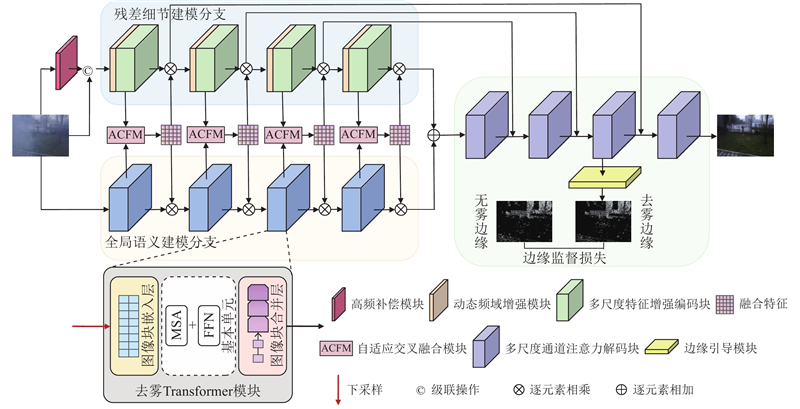
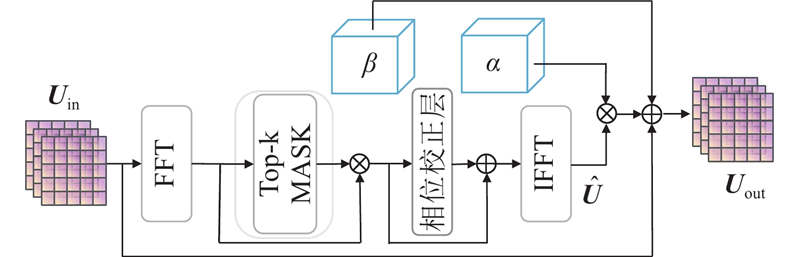
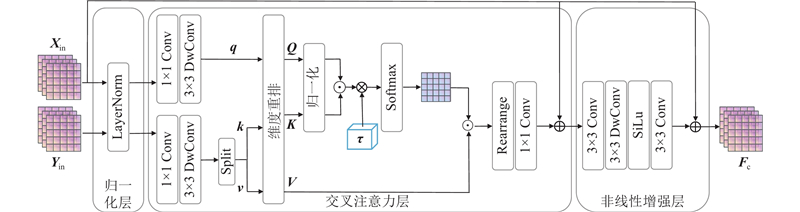
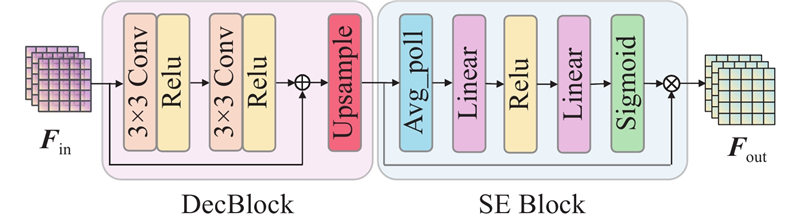
Abstract An interactive dual-branch image dehazing network based on dynamic frequency-domain modulation was proposed in order to address the limitation of existing image dehazing method in diverse and complex haze scene. A parallel encoder composed of a global semantic modeling branch and a residual detail modeling branch was constructed to capture global semantic information and local texture feature, respectively. An adaptive cross fusion module was introduced to enable dynamic interaction between cross-branch feature and enhance cross-feature collaboration capability. A dynamic frequency-domain enhancement module was designed to strengthen the response of the model to high-frequency detail and complex haze region. An edge-guided auxiliary supervision mechanism was introduced in the decoder, which formed complementary constraint with frequency-domain enhancement to guide the network to focus on the image contour. Then detail restoration and visual clarity were improved. The experimental results on the RESIDE, NH-HAZE, O-HAZE and I-HAZE datasets demonstrate that the proposed method achieves stronger structure restoration capability and better visual consistency. PSNR and SSIM reached 24.93 dB and 0.812 6 on the I-HAZE dataset, respectively, which were improved by 2.02 dB and 0.0496 compared with the second-best method.
|
|
Received: 29 July 2025
Published: 06 May 2026
|
|
|
| Fund: 国家自然科学基金资助项目(62063014);甘肃省高等学校产业支撑计划资助项目(2021CYZC-04);甘肃省优秀研究生“创新之星”项目(2025CXZX-681). |
基于动态频域调制的交互式图像去雾网络
针对现有图像去雾方法在多样性复杂雾气场景中的不足,提出基于动态频域调制的交互式双分支图像去雾网络. 构建由全局语义建模分支与残差细节建模分支组成的并行编码器,分别捕捉图像的全局语义信息与局部纹理特征,提出自适应交叉融合模块,实现跨分支特征的动态交互,提升特征协同能力. 设计动态频域增强模块,强化模型对高频细节与复杂雾气区域的响应能力. 在解码器中引入边缘辅助监督,与频域增强形成互补约束,引导网络关注图像轮廓,提升细节恢复能力及视觉清晰度. 在RESIDE、NH-HAZE、O-HAZE和I-HAZE数据集上的实验结果表明,所提方法具备更强的结构还原能力与视觉一致性,在I-HAZE数据集上,PSNR和SSIM分别达到24.93 dB和0.812 6,较次优方法分别提升了2.02 dB和0.049 6.
关键词:
图像去雾,
双分支结构,
特征交互,
频域调制,
边缘引导
|
|
| [1] |
孟小哲, 冯钰新, 苏卓, 等 基于不变学习的真实雾霾去除方法[J]. 浙江大学学报: 工学版, 2024, 58 (2): 268- 278
MENG Xiaozhe, FENG Yuxin, SU Zhuo, et al Real-world dehazing method with invariant learning[J]. Journal of Zhejiang University: Engineering Science, 2024, 58 (2): 268- 278
|
|
|
| [2] |
LI Y, LING Q, AN Y, et al DHC-net: a remote sensing object detection under haze and class imbalance[J]. IEEE Transactions on Geoscience and Remote Sensing, 2025, 63: 4703016
|
|
|
| [3] |
THANGARASU G, KANNAN K N, RAMAMOORTHY M, et al. Artificial intelligence-driven image dehazing using deep convolutional neural networks for enhanced satellite imagery perception [C]//Proceedings of the IEEE 15th Symposium on Computer Applications and Industrial Electronics. Penang: IEEE, 2025: 1–6.
|
|
|
| [4] |
SI Y, CHEN L, ZHENG Z, et al A novel algorithm of haze identification based on FY3D/MERSI-II remote sensing data[J]. Remote Sensing, 2023, 15 (2): 438
doi: 10.3390/rs15020438
|
|
|
| [5] |
HOWARD J N Scattering phenomena: optics of the atmosphere. scattering by molecules and particles[J]. Science, 1977, 196 (4294): 1084- 1085
|
|
|
| [6] |
HE K, SUN J, TANG X Single image haze removal using dark channel prior[J]. IEEE Transactions on Pattern Analysis and Machine Intelligence, 2011, 33 (12): 2341- 2353
doi: 10.1109/TPAMI.2010.168
|
|
|
| [7] |
NANDINI B M, KAULGUD N. Wavelet-based method for enhancing the visibility of hazy images using color attenuation prior [C]//International Conference on Recent Trends in Electronics and Communication. Mysore: IEEE, 2023: 1–6.
|
|
|
| [8] |
CAI B, XU X, JIA K, et al DehazeNet: an end-to-end system for single image haze removal[J]. IEEE Transactions on Image Processing, 2016, 25 (11): 5187- 5198
doi: 10.1109/TIP.2016.2598681
|
|
|
| [9] |
REN W, LIU S, ZHANG H, et al. Single image dehazing via multi-scale convolutional neural networks [C]// European Conference on Computer Vision. Amsterdam: Springer, 2016: 154–169.
|
|
|
| [10] |
LI B, PENG X, WANG Z, et al. Aod-net: all-in-one dehazing network [C]// IEEE International Conference on Computer Vision. Venice: IEEE, 2017: 4770–4778.
|
|
|
| [11] |
LIU X, MA Y, SHI Z, et al. Griddehazenet: attention-based multi-scale network for image dehazing [C]// IEEE/CVF International Conference on Computer Vision. Seoul: IEEE, 2019: 7314–7323.
|
|
|
| [12] |
HU J, SHEN L, SUN G. Squeeze-and-excitation networks [C]// IEEE Conference on Computer Vision and Pattern Recognition. Salt Lake City: IEEE, 2018: 7132–7141.
|
|
|
| [13] |
QIN X, WANG Z, BAI Y, et al. FFA-Net: feature fusion attention network for single image dehazing [C]// AAAI Conference on Artificial Intelligence. New York: AAAI Press, 2020: 11908–11915.
|
|
|
| [14] |
SONG Y, HE Z, QIAN H, et al Vision transformers for single image dehazing[J]. IEEE Transactions on Image Processing, 2023, 32: 1927- 1941
doi: 10.1109/TIP.2023.3256763
|
|
|
| [15] |
MOU C, WANG Q, ZHANG J. Deep generalized unfolding networks for image restoration [C]//IEEE/CVF Conference on Computer Vision and Pattern Recognition. New Orleans: IEEE, 2022: 17378–17389.
|
|
|
| [16] |
FU M, LIU H, YU Y, et al. Dw-gan: a discrete wavelet transform gan for nonhomogeneous dehazing [C]// IEEE/CVF Conference on Computer Vision and Pattern Recognition. [S. l.]: IEEE, 2021: 203–212.
|
|
|
| [17] |
WANG Z, CUN X, BAO J, et al. Uformer: a general U-shaped transformer for image restoration [C]//IEEE/CVF Conference on Computer Vision and Pattern Recognition. New Orleans: IEEE, 2022: 17662–17672.
|
|
|
| [18] |
XU J, CHEN Z X, LUO H, et al An efficient dehazing algorithm based on the fusion of transformer and convolutional neural network[J]. Sensors, 2022, 23 (1): 43
doi: 10.3390/s23010043
|
|
|
| [19] |
LIU Z, LIN Y, CAO Y, et al. Swin transformer: hierarchical vision transformer using shifted windows [C]//IEEE/CVF International Conference on Computer Vision. Montreal: IEEE, 2021: 9992–10002.
|
|
|
| [20] |
CHEN L C, PAPANDREOU G, KOKKINOS I, et al DeepLab: semantic image segmentation with deep convolutional nets, atrous convolution, and fully connected CRFs[J]. IEEE Transactions on Pattern Analysis and Machine Intelligence, 2017, 40 (4): 834- 848
|
|
|
| [21] |
ZAMIR S W, ARORA A, KHAN S, et al. Restormer: efficient transformer for high-resolution image restoration [C]//IEEE/CVF Conference on Computer Vision and Pattern Recognition. New Orleans: IEEE, 2022: 5728–5739.
|
|
|
| [22] |
LAI W S, HUANG J B, AHUJA N, et al. Deep Laplacian pyramid networks for fast and accurate super-resolution [C]//IEEE Conference on Computer Vision and Pattern Recognition. Honolulu: IEEE, 2017: 5835–5843.
|
|
|
| [23] |
ZAMIR S W, ARORA A, KHAN S, et al. Multi-stage progressive image restoration [C]// IEEE/CVF Conference on Computer Vision and Pattern Recognition. Nashville: IEEE, 2021: 14821–14831.
|
|
|
| [24] |
PASZKE A, GROSS S, MASSA F, et al. Pytorch: an imperative style, high-performance deep learning library [C]// Advances in Neural Information Processing Systems. Vancouver: Curran Associates, 2019: 8024–8035.
|
|
|
| [25] |
LI B, REN W, FU D, et al Benchmarking single-image dehazing and beyond[J]. IEEE Transactions on Image Processing, 2018, 28 (1): 492- 505
|
|
|
| [26] |
ANCUTI C O, ANCUTI C, TIMOFTE R. NH-HAZE: an image dehazing benchmark with non-homogeneous hazy and haze-free images [C]// IEEE/CVF Conference on Computer Vision and Pattern Recognition Workshops. Seattle: IEEE, 2020: 444–445.
|
|
|
| [27] |
ANCUTI C O, ANCUTI C, TIMOFTE R, et al. O-haze: a dehazing benchmark with real hazy and haze-free outdoor images [C]// IEEE Conference on Computer Vision and Pattern Recognition Workshops. Salt Lake: IEEE, 2018: 754–762.
|
|
|
| [28] |
ANCUTI C, ANCUTI C O, TIMOFTE R, et al. I-HAZE: a dehazing benchmark with real hazy and haze-free indoor images [C]// International Conference on Advanced Concepts for Intelligent Vision Systems. Poitiers: Springer, 2018: 620–631.
|
|
|
| [29] |
CHEN D, HE M, FAN Q, et al. Gated context aggregation network for image dehazing and deraining [C]// IEEE Winter Conference on Applications of Computer Vision. Waikoloa: IEEE, 2019: 1375–1383.
|
|
|
| [30] |
ZHENG Y, ZHAN J, HE S, et al. Curricular contrastive regularization for physics-aware single image dehazing [C]// IEEE/CVF Conference on Computer Vision and Pattern Recognition. Vancouver: IEEE, 2023: 5785–5794.
|
|
|
| [31] |
CHEN Z, HE Z, LU Z M DEA-Net: single image dehazing based on detail-enhanced convolution and content-guided attention[J]. IEEE Transactions on Image Processing, 2024, 33: 1002- 1015
doi: 10.1109/TIP.2024.3354108
|
|
|
|
Viewed |
|
|
|
Full text
|
|
|
|
|
Abstract
|
|
|
|
|
Cited |
|
|
|
|
| |
Shared |
|
|
|
|
| |
Discussed |
|
|
|
|