| Theory and Method of Mechanical Design |
|
|
|
|
| Uncertainty analysis of high-dimensional full-field structural response based on evidence theory |
Yue ZHAO1( ),Jinhe ZHANG2,3,Jinning ZHI1 ),Jinhe ZHANG2,3,Jinning ZHI1 |
1.School of Mechanical Engineering, Taiyuan University of Science and Technology, Taiyuan 030024, China
2.College of Mechanical and Vehicle Engineering, Hunan University, Changsha 410082, China
3.State Key Laboratory of Advanced Design and Manufacturing Technology for Vehicle, Hunan University, Changsha 410082, China |
|
|
|
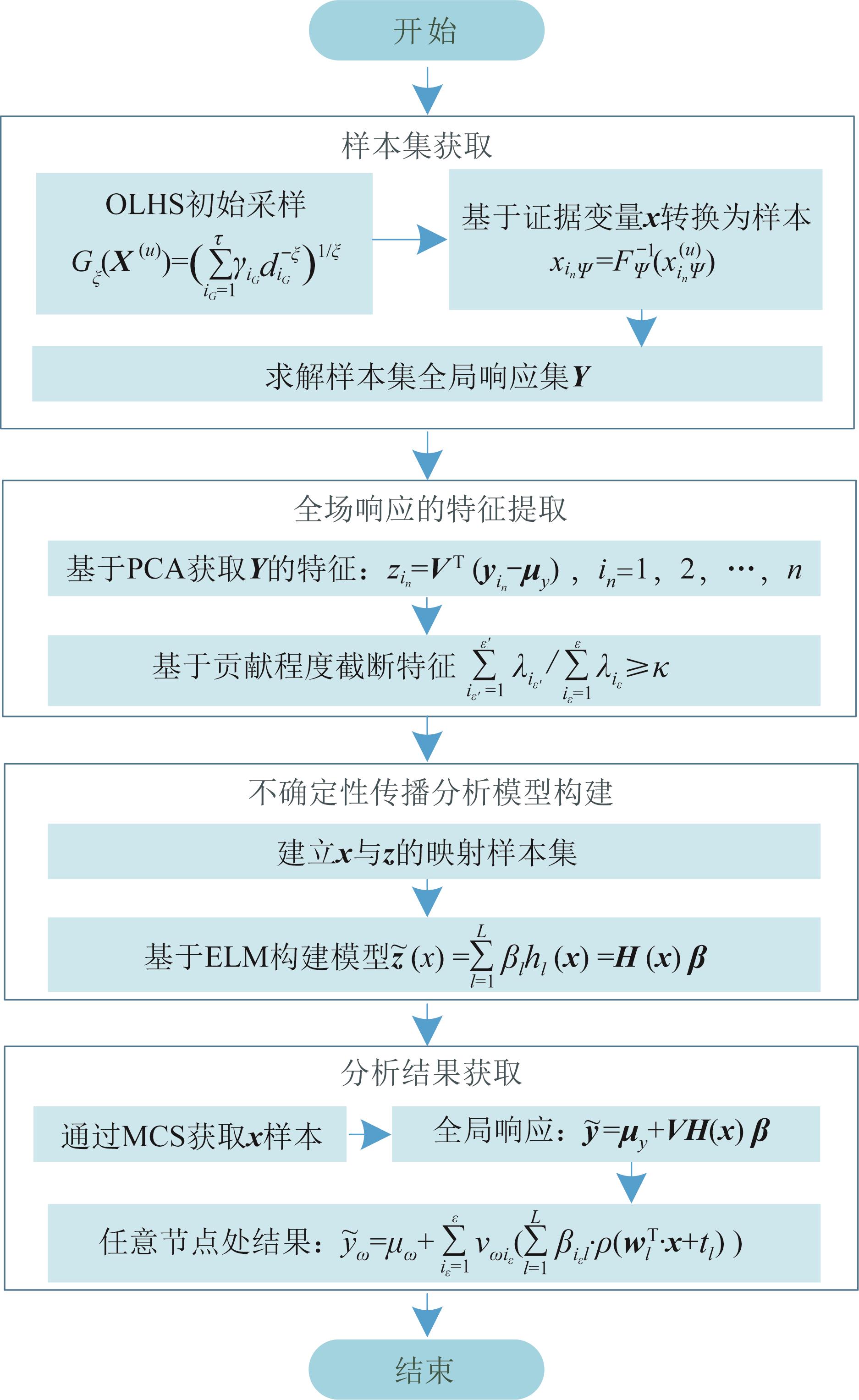
Abstract The propagation analysis of high-dimensional structural responses under complex uncertain variables is prone to problems such as low modeling efficiency and poor analytical accuracy. To address this issue, a rapid analysis method for high-dimensional structural response uncertainty based on evidence theory was proposed. Firstly, the basic probability assignment of evidence variables was utilized to generate sample sets efficiently via optimal Latin hypercube sampling.Secondly, principal component analysis was applied to reduce the dimensionality of the high-dimensional structural responses, extracting low-dimensional features and eigenvectors to decrease modeling complexity. Finally, an extreme learning machine was employed to construct the mapping relationship between the uncertainty parameters and the low-dimensional features, enabling the prediction of uncertainty propagation at any position of the high-dimensional responses with respect to the input variables. Validation through the examples demonstrated that the proposed method could effectively quantify the uncertainty distribution at arbitrary positions of both high-dimensional time-domain and spatial responses, achieving high accuracy with relatively high modeling efficiency. The proposed method can significantly reduce the complexity of uncertainty analysis for high-dimensional full-field responses and serve as an effective tool for uncertainty propagation analysis of complex engineering structures.
|
|
Received: 30 September 2025
Published: 28 April 2026
|
|
|
基于证据理论的结构高维全场响应不确定性分析
当结构存在复杂不确定性变量时,开展高维响应传播分析可能面临建模效率低与分析精度差等问题。基于此,提出了一种基于证据理论的结构高维响应不确定性快速分析方法。首先,依据证据变量的基本可信度分配,结合最优拉丁超立方采样技术,高效生成样本集;其次,采用主成分分析技术对结构高维全场响应进行降维处理,提取低维特征与特征向量,以降低建模复杂度;最后,利用极限学习机构建不确定性参数与低维特征之间的映射关系,进而预测输入变量对结构高维响应任意位置的不确定性传播结果。算例验证表明,对于高维时域响应与空间响应,所提出的方法均能有效量化结构响应中任意位置的不确定性分布,并在保证较高建模效率的同时实现高精度求解。所提出的方法能够显著降低高维全场响应不确定性分析的复杂度,为复杂工程结构的不确定性传播分析提供了一种有效的工具。
关键词:
结构不确定性,
证据理论,
极限学习机,
不确定性传播
|
|
| [[1]] |
BI S, BEER M, COGAN S, et al. Stochastic model updating with uncertainty quantification: an overview and tutorial[J]. Mechanical Systems and Signal Processing, 2023, 204: 110784.
|
|
|
| [[2]] |
CAO L X, LIU J, XIE L, et al. Non-probabilistic polygonal convex set model for structural uncertainty quantification[J]. Applied Mathematical Modelling, 2021, 89: 504-518.
|
|
|
| [[3]] |
HÜLLERMEIER E, WAEGEMAN W. Aleatoric and epistemic uncertainty in machine learning: an introduction to concepts and methods[J]. Machine Learning, 2021, 110(3): 457-506.
|
|
|
| [[4]] |
毛晨洋, 赵岩, 刘凡. 路面不平顺作用下具有不确定参数车辆系统随机振动分析[J]. 振动工程学报, 2025, 38(9): 1967-1976. doi:10.16385/j.cnki.issn.1004-4523.202307022
MAO C Y, ZHAO Y, LIU F. Random vibration analysis of vehicle systems with uncertain parameters under the action of road roughness [J]. Journal of Vibration Engineering, 2025, 38(9):1967-1976.
doi: 10.16385/j.cnki.issn.1004-4523.202307022
|
|
|
| [[5]] |
马正琰, 欧阳衡, 郝志杰, 等. 基于聚类椭球模型的机械系统不确定性分析方法[J]. 工程设计学报, 2025, 32(2): 141-150.
MA Z Y, OUYANG H, HAO Z J, et al. Uncertainty analysis method for mechanical system based on multi-cluster ellipsoidal model[J]. Chinese Journal of Engineering Design, 2025, 32(2): 141-150.
|
|
|
| [[6]] |
WU J H, ZHANG D Q, LIU J, et al. A moment approach to positioning accuracy reliability analysis for industrial robots[J]. IEEE Transactions on Reliability, 2019, 69(2): 699-714.
|
|
|
| [[7]] |
乔心州, 李佳辉, 方秀荣, 等. 一种结构不确定性分析的新型非概率凸集模型[J]. 固体力学学报, 2025, 46(2): 257-274.
QIAO X Z, LI J H, FANG X R, et al. A new type of non-probabilistic convex model for structural uncertainty analysis[J]. Chinese Journal of Solid Mechanics, 2025, 46(2):257-274.
|
|
|
| [[8]] |
WANG X D, SONG Y F. Uncertainty measure in evidence theory with its applications[J]. Applied Intelligence, 2018, 48(7): 1672-1688.
|
|
|
| [[9]] |
SHAH H, HOSDER S, WINTER T. A mixed uncertainty quantification approach using evidence theory and stochastic expansions[J]. International Journal for Uncertainty Quantification, 2015, 5(1):21-48.
|
|
|
| [[10]] |
LI Z, CAO L X, HUO M S, et al. Evidence-based uncertainty quantification for bending properties of bimetal composites[J]. Applied Mathematical Modelling, 2023, 121: 59-74.
|
|
|
| [[11]] |
ZHANG J X. Modern Monte Carlo methods for efficient uncertainty quantification and propagation: a survey[J]. Wiley Interdisciplinary Reviews: Computational Statistics, 2021, 13(5): e1539.
|
|
|
| [[12]] |
HOU T F, NUYENS D, ROELS S, et al. Quasi-Monte Carlo based uncertainty analysis: sampling efficiency and error estimation in engineering applications[J]. Reliability Engineering & System Safety, 2019, 191: 106549.
|
|
|
| [[13]] |
GU M H, CHO C, CHU H Y, et al. Uncertainty propagation on a nonlinear measurement model based on Taylor expansion[J]. Measurement and Control, 2021, 54(3/4): 209-215.
|
|
|
| [[14]] |
WANG T, LU D G, TAN Y Q. Refined dimension-reduction integration method for uncertainty propagation in stochastic systems: estimation of statistical moments[J]. Reliability Engineering & System Safety, 2025, 256: 110753.
|
|
|
| [[15]] |
REHME M F, FRANZELIN F, PFLÜGER D. B-splines on sparse grids for surrogates in uncertainty quantification[J]. Reliability Engineering & System Safety, 2021, 209: 107430.
|
|
|
| [[16]] |
XIE H C, LI J W, LIU H B, et al. An efficient uncertainty propagation analysis method of non-parameterized P-boxes based on dimension-reduction integral and maximum entropy estimation[J]. Structural and Multidisciplinary Optimization, 2023, 66(12): 258.
|
|
|
| [[17]] |
WANG L Q, YANG G L. An interval uncertainty propagation method using polynomial chaos expansion and its application in complicated multibody dynamic systems[J]. Nonlinear dynamics, 2021, 105(1): 837-858.
|
|
|
| [[18]] |
LUO C Q, ZHU S P, KESHTEGAR B, et al. Active Kriging-based conjugate first-order reliability method for highly efficient structural reliability analysis using resample strategy[J]. Computer Methods in Applied Mechanics and Engineering, 2024, 423: 116863.
|
|
|
| [[19]] |
HU Z L, MANSOUR R, OLSSON M, et al. Second-order reliability methods: a review and comparative study[J]. Structural and Multidisciplinary Optimization, 2021, 64(6): 3233-3263.
|
|
|
| [[20]] |
李扬, 徐军. 数据驱动的非高斯随机过程模拟[J]. 振动工程学报, 2025, 38(9): 1995-2001. doi:10.16385/j.cnki.issn.1004-4523.202309048
LI Y, XU J. Data-driven simulation of non-Gaussian stochastic processes[J]. Journal of Vibration Engineering, 2025,38(9):1995-2001.
doi: 10.16385/j.cnki.issn.1004-4523.202309048
|
|
|
| [[21]] |
孟原, 史宝军, 张德权. Kriging-高维代理模型建模方法研究与改进[J]. 机械工程学报, 2024, 60(5): 249-263. doi:10.3901/jme.2024.05.249
MENG Y, SHI B J, ZHANG D Q. Research and improvement of Kriging-HDMR modeling method[J]. Journal of Mechanical Engineering,2024,60(5):249-263.
doi: 10.3901/jme.2024.05.249
|
|
|
| [[22]] |
SHI Y, NIU L Z, BEER M. Adaptive artificial neural network for uncertainty propagation[J]. Journal of Reliability Science and Engineering, 2025, 1(1): 015002-015002.
|
|
|
| [[23]] |
JUNIOR F E, ALMEIDA I F. Machine learning RBF-based surrogate models for uncertainty quantification of age and time-dependent fracture mechanics[J]. Engineering Fracture Mechanics, 2021, 258: 108037.
|
|
|
| [[24]] |
ZHANG K, CHEN N, LIU J, et al. An efficient meta-model-based method for uncertainty propagation problems involving non-parameterized probability-boxes[J]. Reliability Engineering & System Safety, 2023, 238: 109477.
|
|
|
| [[25]] |
ZHAO Y, LIU J, HE Z L, et al. Rapid dynamic analysis for structures with variable system parameters through multi-fidelity model[J]. Computers & Structures, 2023, 285: 107072.
|
|
|
| [[26]] |
CAO L X, LIU J, MENG X H, et al. Inverse uncertainty quantification for imprecise structure based on evidence theory and similar system analysis[J]. Structural and Multidisciplinary Optimization, 2021, 64(4): 2183-2198.
|
|
|
| [[27]] |
CAO L X, ZHAO Y. Uncertainty quantification for structural response field with ultra-high dimensions[J]. International Journal of Mechanical Sciences, 2024, 271: 109110.
|
|
|
| [[28]] |
WANG J, LU S Y, WANG S H, et al. A review on extreme learning machine[J]. Multimedia Tools and Applications, 2022, 81(29): 41611-41660.
|
|
|
|
Viewed |
|
|
|
Full text
|
|
|
|
|
Abstract
|
|
|
|
|
Cited |
|
|
|
|
| |
Shared |
|
|
|
|
| |
Discussed |
|
|
|
|