| Theory and Method of Mechanical Design |
|


|
|
|
| Hazard level assessment method and system for bridge crane based on FFT-BN model |
Qing DONG1( ),Junqi LI1,Gening XU1,Shuguang NIU2,Keyuan ZHAO1 ),Junqi LI1,Gening XU1,Shuguang NIU2,Keyuan ZHAO1 |
1.School of Mechanical Engineering, Taiyuan University of Science and Technology, Taiyuan 030024, China
2.Taiyuan Heavy Machinery Group Co. , Ltd. , Taiyuan 030024, China |
|
|
|
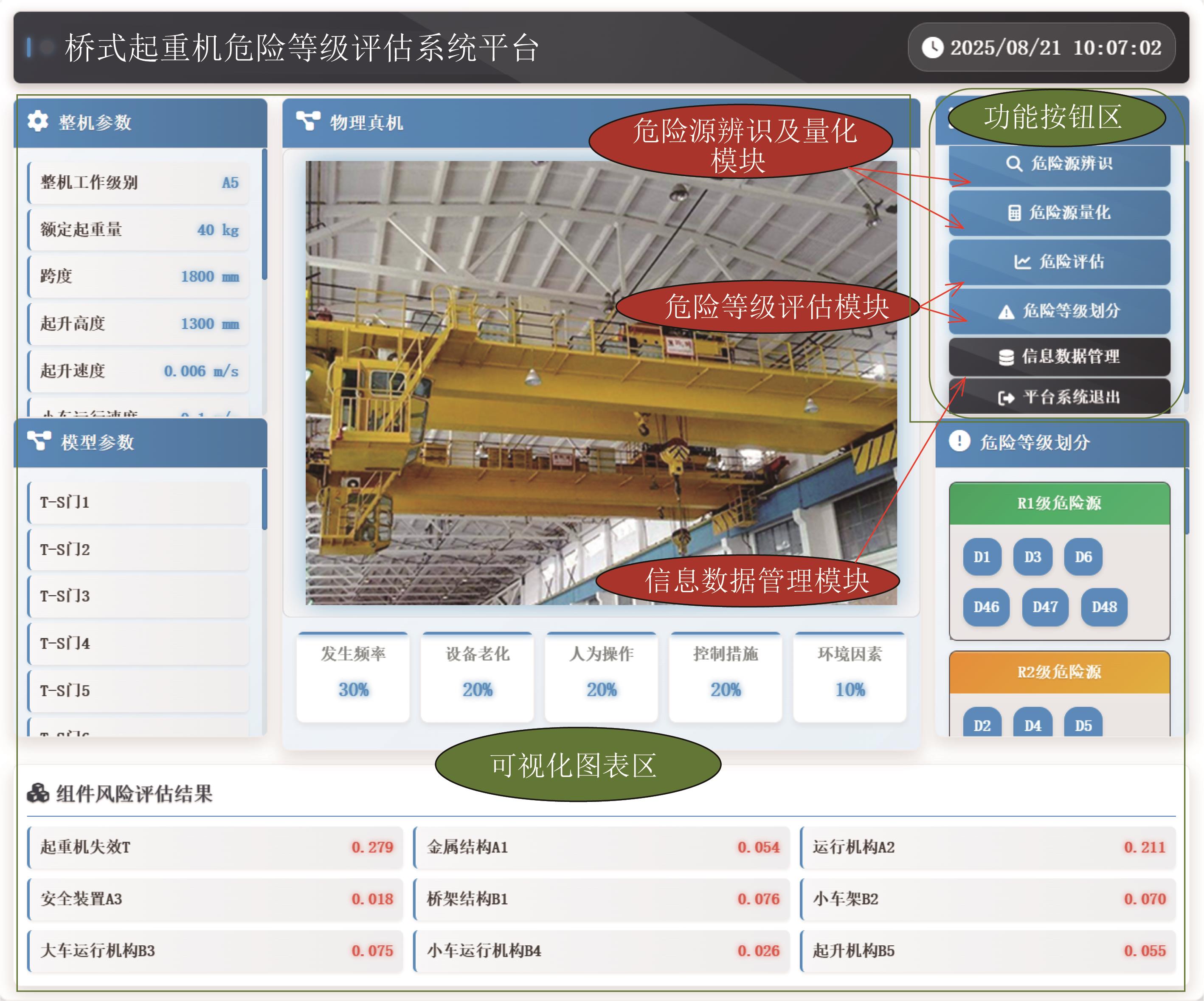
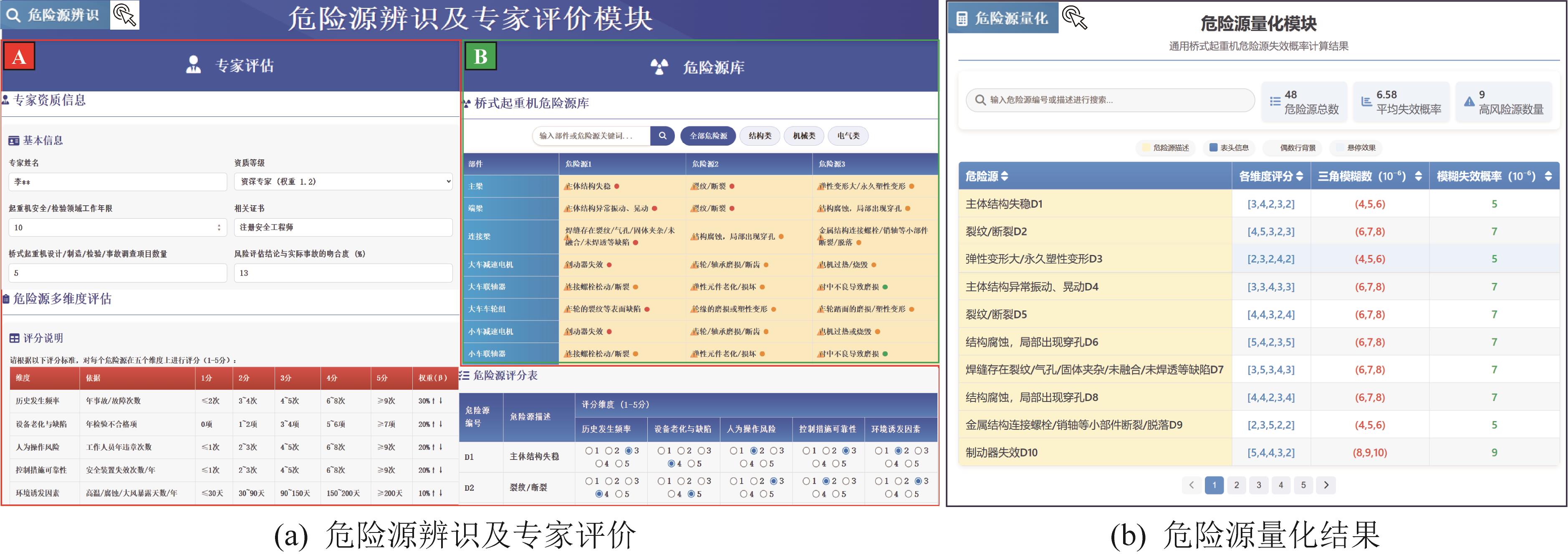
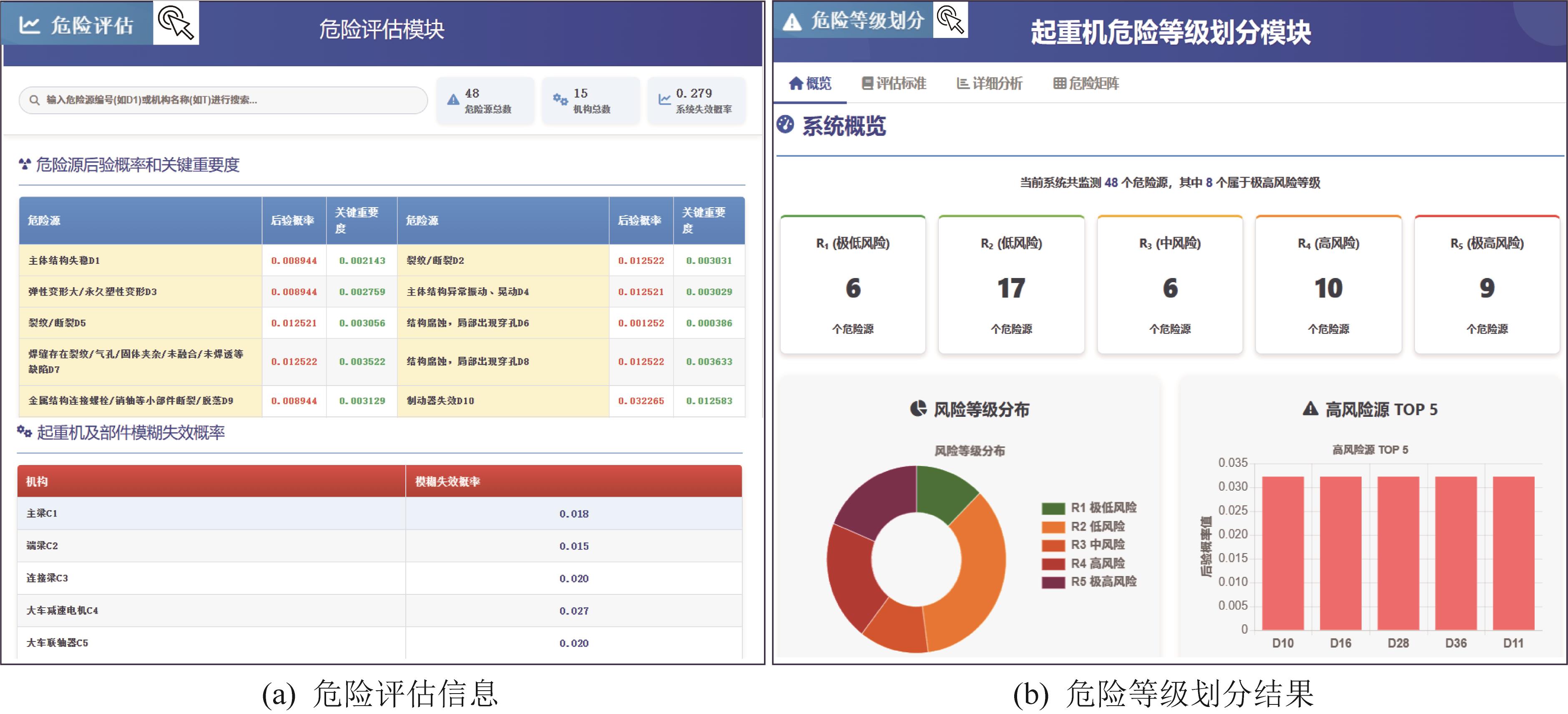
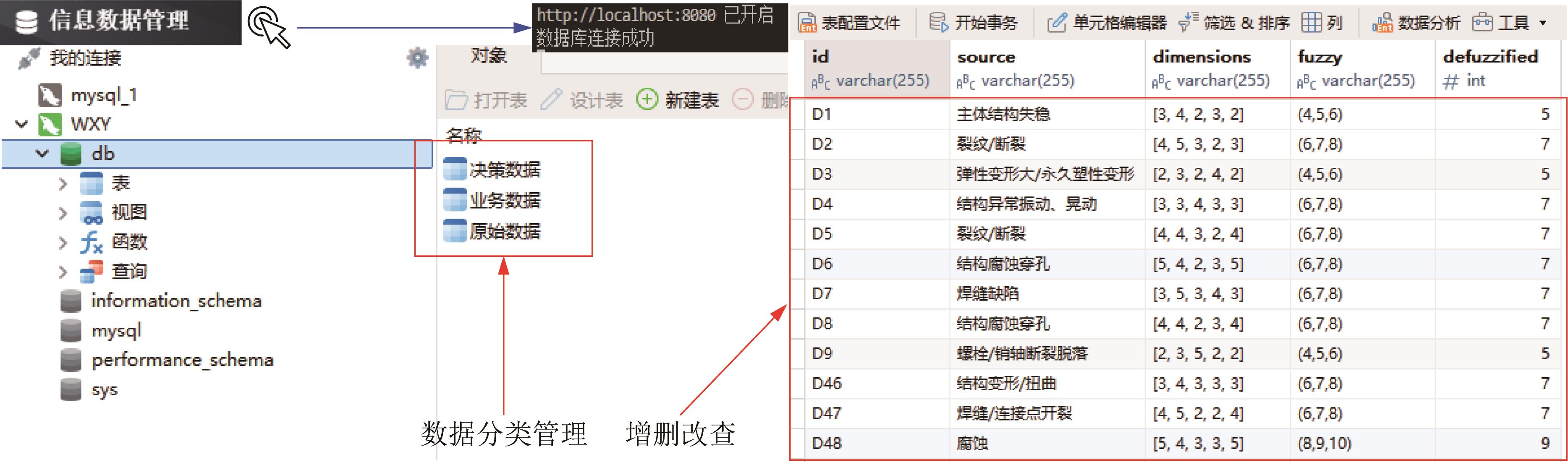
Abstract To implement effective prevention and control of hazards faced by cranes at the source of design, it is necessary to address core issues existing in active bridge cranes, such as incomplete hazard source identification, lack of quantitative assessment systems, and limitations of risk assessment models. Therefore, a hazard level assessment method for bridge cranes based on FFT-BN (fuzzy fault tree-Bayesian network) model is proposed, and a dedicated system platform is developed. Focusing on the structure and components of bridge cranes, a refined hazard source identification process was established through systematic failure analysis to achieve comprehensive coverage of potential risks. An expert evaluation quantitative system was constructed, standard quantitative indicators were designed, and hazard sources were quantitatively characterized. A hazard level assessment model based on FFT-BN was proposed, which combined the failure logic analysis capability of FFT with the uncertainty reasoning advantage of BN, to achieve dynamic quantitative assessment and level classification of complex risks while improving the model accuracy and efficiency. A dedicated hazard level assessment system platform for bridge cranes was developed, realizing the intelligent innovation of the assessment process and significantly improving the application efficiency in engineering practice. Taking the in-service QD40 t-22.5 m-9 m general bridge crane as an example, the engineering feasibility and scenario applicability of the proposed method were verified, providing effective solutions and tool support for the improvement of equipment intrinsic safety and active prevention of accidents.
|
|
Received: 15 August 2025
Published: 01 March 2026
|
|
|
基于FFT-BN模型的桥式起重机危险等级评估方法及系统
为了在设计源头对起重机所面临的危险实施有效防控,需着力解决现役桥式起重机存在的危险源辨识不全面、量化评估体系缺失及风险评估模型局限性等核心问题。为此,提出了基于FFT-BN(fuzzy fault tree-Bayesian network,模糊故障树-贝叶斯网络)模型的桥式起重机危险等级评估方法,并开发了专用型系统平台。聚焦桥式起重机的结构与零部件,通过系统性失效分析建立精细化的危险源辨识流程,以实现潜在风险的全覆盖;构建专家评价量化体系,设计标准的定量指标,并对危险源进行量化表征;提出基于FFT-BN的危险等级评估模型,结合FFT的失效逻辑分析能力与BN的不确定性推理优势,在提升模型精度与效率的同时实现复杂风险的动态量化评估与等级划分;开发专用型桥式起重机危险等级评估系统平台,实现了评估流程的智能化革新,大幅提升工程实际的应用效率。以在役QD40 t-22.5 m-9 m通用桥式起重机为例,验证了所提出方法的工程可行性与场景适用性,为设备本质安全提升与事故主动预防提供了有效的解决方案和工具支持。
关键词:
危险源辨识,
危险源量化,
模糊故障树-贝叶斯网络,
桥式起重机,
危险等级
|
|
| [[1]] |
ZHANG Y, YANG F, YUAN H, et al. 3D reconstruction of coal pile based on visual scanning of bridge crane[J]. Measurement, 2025, 242: 116146.
|
|
|
| [[2]] |
安慧, 黄艾, 安敏, 等. 基于模糊故障树的建筑施工高处坠落全面风险评估[J]. 科学技术与工程, 2022, 22(19): 8568-8576.
AN H, HUANG A, AN M, et al. Comprehensive risk assessment of building construction falling from height based on fuzzy fault tree[J]. Science Technology and Engineering, 2022, 22(19): 8568-8576.
|
|
|
| [[3]] |
SHIOKARI M, ITOH H, YUZUI T, et al. Structure model-based hazard identification method for autonomous ships[J]. Reliability Engineering & System Safety, 2024, 247: 110046.
|
|
|
| [[4]] |
SUNARYO, HAMKA M A. Safety risks assessment on container terminal using hazard identification and risk assessment and fault tree analysis methods[J]. Procedia Engineering, 2017, 194: 307-314.
|
|
|
| [[5]] |
SHEN Y H, LÜ H, HU Y Q, et al. Preliminary hazard identification for qualitative risk assessment on onboard hydrogen storage and supply systems of hydrogen fuel cell vehicles[J]. Renewable Energy, 2023, 212: 834-854.
|
|
|
| [[6]] |
刘永强, 朱斌, 任海文, 等. 基于BIM技术的大型水闸工程施工危险源辨识系统设计[J]. 水电能源科学, 2023, 41(5): 170-173, 134.
LIU Y Q, ZHU B, REN H W, et al. Identification system design of hazard sources of large-scale sluice engineering based on BIM technology[J]. Water Resources and Power, 2023, 41(5): 170-173, 134.
|
|
|
| [[7]] |
WOLNIEWICZ Ł, MARDEUSZ E. Fuzzy logic-based expert evaluation of tram driver's console fidelity in a universal simulator[J]. Applied Sciences, 2025, 15(16): 9048.
|
|
|
| [[8]] |
SHEN S L, LIN S S, ZHOU A N. A cloud model-based approach for risk analysis of excavation system[J]. Reliability Engineering & System Safety, 2023, 231: 108984.
|
|
|
| [[9]] |
YUCESAN M, GUL M, CELIK E. A holistic FMEA approach by fuzzy-based Bayesian network and best-worst method[J]. Complex & Intelligent Systems, 2021, 7(3): 1547-1564.
|
|
|
| [[10]] |
HE W, LIN Z L, LI W, et al. The comprehensive safety assessment method for complex construction crane accidents based on scenario analysis: a case study of crane accidents[J]. Computers & Industrial Engineering, 2025, 199: 110716.
|
|
|
| [[11]] |
CHEN Z P, LI Z W, HUANG C L, et al. Safety assessment method of bridge crane based on cluster analysis and neural network[J]. Procedia Computer Science, 2018, 131: 477-484.
|
|
|
| [[12]] |
LI A H. Risk assessment of crane operation hazards using modified FMEA approach with Z-number and set pair analysis[J]. Heliyon, 2024, 10(9): e28603.
|
|
|
| [[13]] |
吴峰崎, 刘兆基, 刘龙, 等. 基于云模型和组合赋权的岸边集装箱桥式起重机金属结构安全评估[J]. 中国特种设备安全, 2024, 40(8): 52-57, 71.
WU F Q, LIU Z J, LIU L, et al. Safety assessment of quayside container crane metal structures based on cloud modeling and DEMATEL-CRITIC[J]. China Special Equipment Safety, 2024, 40(8): 52-57, 71.
|
|
|
| [[14]] |
ZHONG H Y, CHEN L Y, ANTWI-AFARI M F, et al. Dynamic risk assessment of tower crane operations by integrating functional resonance analysis method and Bayesian network[J]. Developments in the Built Environment, 2025, 23: 100699.
|
|
|
| [[15]] |
European Committee for Standardization. Cranes-bridge and gantry cranes: EN 15011:2020 [S]. Brussels: [s.n.], 2020.
|
|
|
| [[16]] |
中国机械工业联合会. 起重机械 危险源辨识: [S]. 北京: 中国标准出版社, 2025.
China Machinery Industry Federation. Lifting appliances: hazard identification: [S]. Beijing: Standards Press of China, 2025.
|
|
|
| [[17]] |
European Committee for Standardization. Crane safety-general design-Part 2: load actions: EN 13001-2:2021 [S]. Brussels: [s.n.], 2021.
|
|
|
| [[18]] |
袁凡雨, 米琴, 陈杰, 等. 基于事故树分析的重大事故隐患评判方法[J]. 中国安全科学学报, 2025, 35(6): 37-41.
YUAN F Y, MI Q, CHEN J, et al. Evaluation method for major accident hazards based on accident tree analysis[J]. China Safety Science Journal, 2025, 35(6): 37-41.
|
|
|
| [[19]] |
任耀军, 袁修久, 黄林. q阶三角犹豫模糊BM算子及其多属性决策应用[J]. 系统工程与电子技术, 2022, 44(1): 181-191.
REN Y J, YUAN X J, HUANG L. q-rung hesitant triangular fuzzy BM operator and its application in multiple criteria decision making[J]. Systems Engineering and Electronics, 2022, 44(1): 181-191.
|
|
|
| [[20]] |
房锐, 张琪, 胡澄宇, 等. 基于风险矩阵的干线公路弯道路段交通冲突风险评估模型[J]. 交通运输系统工程与信息, 2021, 21(2): 166-172.
FANG R, ZHANG Q, HU C Y, et al. Risk assessment model based on risk matrix for traffic conflict on arterial highway bend section[J]. Journal of Transportation Systems Engineering and Information Technology, 2021, 21(2): 166-172.
|
|
|
| [[21]] |
刘若君, 张幼振, 姚克. 基于T-S模糊故障树的煤矿坑道钻机液压动力系统故障诊断研究[J]. 煤田地质与勘探, 2022, 50(12): 194-202.
LIU R J, ZHANG Y Z, YAO K. Fault diagnosis of hydraulic power system for coal mine tunnel drilling rig based on T-S fuzzy fault tree[J]. Coal Geology & Exploration, 2022, 50(12): 194-202.
|
|
|
| [[22]] |
马帜, 罗尧治, 葛慧斌, 等. 基于健康监测数据和贝叶斯网络的结构失效概率评估[J]. 浙江大学学报(工学版), 2023, 57(8): 1551-1561.
MA Z, LUO Y Z, GE H B, et al. Failure probability estimation for structures based on health monitoring data and Bayesian network[J]. Journal of Zhejiang University (Engineering Science), 2023, 57(8): 1551-1561.
|
|
|
|
Viewed |
|
|
|
Full text
|
|
|
|
|
Abstract
|
|
|
|
|
Cited |
|
|
|
|
| |
Shared |
|
|
|
|
| |
Discussed |
|
|
|
|